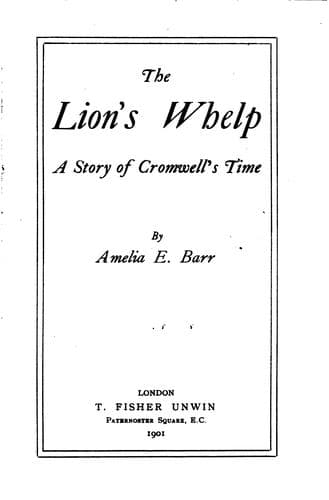
The Lion's Whelp: A Story of Cromwell's TimeBarr, Amelia E.
History
The Lion's Whelp: A Story of Cromwell's Time
Barr, Amelia E.
Great Britain -- History -- Stuarts, 1603-1714 -- Fiction
The strain had been great; the very atmosphere of the place was too
heavy with grief to breathe; she was glad to feel the sunshine and the
fresh wind. She had intended to call on Matilda as she passed through
the city, but she could not throw off the lassitude of hopeless
foreboding that had invaded her mind. It bred fears for Cluny, and she
hastened home, resolving to see Matilda on the following day. But when
she reached Sandy’s House, Mrs. Swaffham met her with a letter in her
hand—"Lady Jevery asks you to come to Matilda, who is in great trouble,"
she said. "Cluny is asleep; if you are not too tired, you would better
go at once, for if the wind keep fair, Captain Jonson thinks to lift
anchor to-morrow night."
So Jane went to her friend. With her, also, she found the grief Death
brings.
"Stephen is slain!" were her first words. She could hardly utter them.
But Jane knew how to comfort Matilda; she could talk to her as she could
not to the ladies of Cromwell’s household. She could take her in her
arms and say all kinds of loving words, blending them with promises and
hopes that had Divinity as their surety. And she could encourage her to
talk away her trouble. "How was Stephen slain?" she asked, "in a duel?"
"No, thank God! He fell, as he himself could have wished, fighting the
enemies of his King. He was with Condé and the Dukes of York and
Gloucester before Dunkirk, and was killed while meeting the rush of
those terrible Ironsides. He died shouting ’_For God and King!_’ and
Camby—one of their officers who comes from Ely—knew Stephen, and he
carried him aside, and gave him water, but he died in five minutes.
Camby wrote me that he said ’_Mother!_’ joyfully, with his last breath."
"Poor Stephen!"
"Oh, indeed ’tis very well to cry, ’poor Stephen,’ when he is beyond
your pity. You might have pitied him when he was alive, that would have
been something to the purpose. All his short, unhappy life has been one
constant battle with Puritans and poverty. Oh, how I hate those
Stuarts! I am thankful to see you can weep for him, Jane. I think you
ought. God knows he loved you well, and most thanklessly. And he is
the last, the last de Wick. Root and branch, the de Wick tree has
perished. I wish I could die also."
"And Cymlin, Matilda?"
"I shall marry Cymlin,—at the proper time."
"You may have sons and daughters."
"I hope not. I pray not. I have had sorrow enough. My father and his
three sons are a good ending for the house. It was built with the
sword, and it has been destroyed by the sword. I want no de Wick like
the men of to-day—traders and gold seekers. And if they were warriors,
the old cares and fears and anxieties would be to live over again. No,
Jane, the line of de Wick is finished.[3] Cymlin and I will be the last
Earl and Countess de Wick. We shall go to Court, and bow to the Stuart,
and be very great people, no doubt."
Public-domain text, read in full here on John Shaqi.
Reviews
Reviews
No reviews yet
Be the first to share your thoughts on this work.
Elsewhere in the archive
Join the Discussion
Join the discussion
Sign in to leave a comment or review.
Sign InorCreate an account