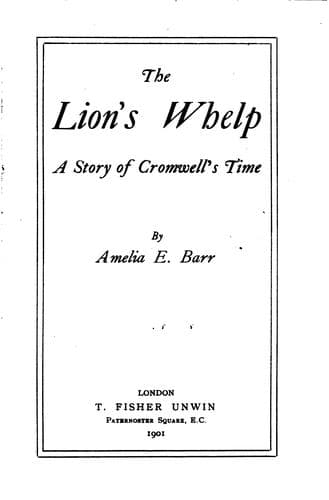
The Lion's Whelp: A Story of Cromwell's TimeBarr, Amelia E.
History
The Lion's Whelp: A Story of Cromwell's Time
Barr, Amelia E.
Great Britain -- History -- Stuarts, 1603-1714 -- Fiction
So the summer days went on, and England had never been so serene and so
secure in her strength and prosperity. Throughout the land the farmer
was busy in his meadows making hay, and watching the green wheat blow
yellow in the warm winds and sunshine. The shepherds were on the fells
counting the ewes and their lambs; the traders busy in their shops; the
ports full of entering and departing vessels, and the whole nation yet
in a mood of triumph over the acquisition of Dunkirk. Cromwell was
working feverishly, and suffering acutely. His favourite child, the
Lady Elizabeth Claypole was still very ill; he had premonitions and
visions of calamity that filled his heart with apprehension, and kept
his soul always on the alert, watching, watching for its coming. It
might be that he alone could meet it and ward it away from those he
loved.
It is certain also that he knew the time for his own departure was at
hand. He said to Doctor Verity, "I have one more fight, John. Dunbar
was a great victory; Worcester was a greater one; but my next fight will
give me the greatest victory of all—’the last enemy that shall be
destroyed is death.’ Do you understand?" And the Doctor made a
movement of affirmation; he could not speak.
Wonderful was the labour the Protector now performed. He directed and
settled the English affairs in France; he arranged the government of the
new English plantations in Jamaica and the West Indies; and he paid
particular attention to the needs and condition of the New England
Colonies, being indeed their protector, and the only English protector
they ever had. He took time to enunciate to France, more strongly than
ever before, the rights of all the Protestants in Europe; and he made
all preparations for calling another Parliament to consider, and settle
more firmly, the business of the English Commonwealth. His work was a
stupendous one, and through it all he showed constantly the feverish
haste of a man who has a great task to perform and sees the sun dropping
to the western horizon. But his heart bore the heaviest share of the
heavy burden. It was as if Death knew that this man’s soul could only
be delivered from the flesh by attacking the citadels of feeling. In
every domestic and social relation—son, husband, father, friend—the
tenderness of his nature made him suffer; and when on the twenty-third
of July Lady Claypole’s illness showed fatal symptoms, he dropped all
business, and for fourteen days and nights hardly left her presence.
And her death on the sixth of August was a crushing and insupportable
blow.
Public-domain text, read in full here on John Shaqi.
Reviews
Reviews
No reviews yet
Be the first to share your thoughts on this work.
Elsewhere in the archive
Join the Discussion
Join the discussion
Sign in to leave a comment or review.
Sign InorCreate an account