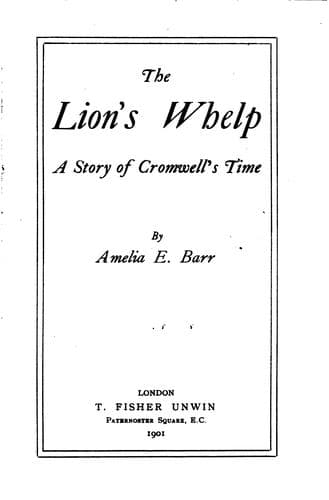
The Lion's Whelp: A Story of Cromwell's TimeBarr, Amelia E.
History
The Lion's Whelp: A Story of Cromwell's Time
Barr, Amelia E.
Great Britain -- History -- Stuarts, 1603-1714 -- Fiction
The next day he went to his desk and began to write, but speedily and
urgently called for Israel Swaffham. When he answered the call, Oliver
was in great physical agony, but he took some papers from a drawer and
said, "When I am no longer here, Israel, give these to my wife. Thurloe
has the key to all State questions; he knows my intents and my judgments
on them. And there is one more charge for you: when all is over, speak
to the army for me. Tell the men to remember me while they live. Truly,
I think they will. Tell them I will take love and boldness to myself,
and plead for them when I am nearer to God than I am now. It may be we
shall serve together again—among the hosts of the Most High. Say to
them my tears hinder my last words, as indeed they do. Now let me lean
on you, Israel. I am going to my last hard fight."
When he reached his room, he stood a moment and looked wistfully round
it. It was but a narrow chamber, but large enough for the awfully
close, near conflict, that he had to fight in it,—a conflict which was
to put asunder flesh and spirit, and within its few feet, with strange,
strong pains deliver the Eternal out of Time, and set free his Immortal
Self from the carnal prison-house of many woes in which he had suffered
for more than fifty-nine years. For ten terrible days and nights the
anguish of this struggle went on unceasingly, sometimes the great
Combatant being "all here" and full of faith and courage, sometimes far
down the shoal of life and reason, and wandering uneasily through bygone
days of battle and distress and darkness. Then Israel held his burning
hands, and listened, while in a voice very far off, he ejaculated such
passages as had then been familiar to him:—"The shield of His mighty men
is made red, the valiant men are in scarlet. The chariots shall rage in
the streets—they shall seem like torches, they shall run like the
lightnings."[4] And once at the midnight when all was still he cried,
"If the Lord had suffered it, then I had died on the battle-field as His
Man of War, with tumult, with shouting and with the sound of the
trumpet."[5]
[4] Nahum 2:4.
[5] Amos 2: 2.
He had turned to face his last enemy on the twenty-fourth of August, and
on the thirtieth there was such a tempest as had never before been seen
in England. Whole forests were laid on the ground; traffic was swept
from the roads and the streets, and the ships from the stormy seas; and
the tide at Deptford, to the dismay of the superstitious, threw up the
carcass of a monstrous whale. The chambers of Whitehall were filled
with the roar of the great winds. The guards leaned on their arms,
praying or talking solemnly together on the prodigy of the storm.
"Michael and the devil had a dispute about the body of Moses," said one
old grizzled trooper to his companion. "Are they fighting about our
Cromwell, think ye, Abel?"
Public-domain text, read in full here on John Shaqi.
Reviews
Reviews
No reviews yet
Be the first to share your thoughts on this work.
Elsewhere in the archive
Join the Discussion
Join the discussion
Sign in to leave a comment or review.
Sign InorCreate an account