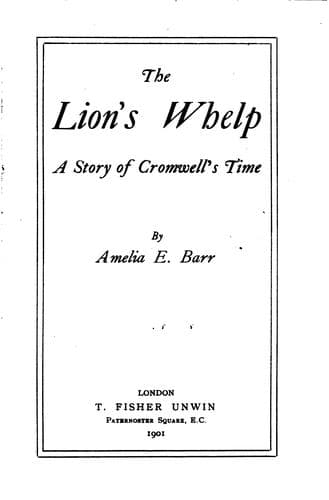
The Lion's Whelp: A Story of Cromwell's TimeBarr, Amelia E.
History
The Lion's Whelp: A Story of Cromwell's Time
Barr, Amelia E.
Great Britain -- History -- Stuarts, 1603-1714 -- Fiction
"Of course not, but Frank is only talking. We have masters now in music
and singing and geography, and I am learning _Morley’s Airs_[1] straight
through, besides roundelays and madrigals. And we have a new
harpsichord, though the Lord General, my father, likes best the organ or
the lute."
[1] Popular and patriotic songs having the same vogue then as _Moore’s
Melodies_ in our era.
"And besides all this," continued Frances, "we are studying the French
tongue, and history, and the use of the globes; and Mrs. Katon comes
twice every week to teach us how to make wax flowers and fruit and take
the new stitches in tatting and embroidery. And, Jane, I have got a
glass bowl full of goldfish. They came from China, and there are no
more of them, I think, in England. Come with me, and you shall see
them."
"Never mind the fish now, Frank," said Mary; "there is the bell for
dinner, and we must answer it at once or we shall grieve mother."
They rose at these words and went quickly to the dining-room. Mrs.
Cromwell, leaning upon the arm of her daughter, Mrs. Ireton, was just
entering it, and Jane wondered silently at the state these simple
country gentry had so easily assumed. Officers of the household, in
rich uniforms, waited on all their movements and served them with
obsequious respect; and they bore their new honours as if they had been
born to the purple. Mrs. Cromwell’s simplicity stood her in the place
of dignity, and the piety and stern republicanism of Mrs. Ireton gave to
her bearing that indifference to outward pomp which passed readily for
inherited nobility, while the beauty of Mrs. Claypole and her love of
splendour fitted her surroundings with more than accidental propriety.
All the women of this famous household were keenly alive to the glory of
those achievements which had placed them in a palace, and all of them
rendered to its great head every title of honour his mighty deeds
claimed as their right.
"The General dines with the Speaker," said Mrs. Cromwell; and she was
herself about to say grace when Doctor Verity entered. He was greeted
with a chorus of welcomes, and readily took his seat at the foot of the
table and spoke the few words of grateful prayer which sweetened and
blessed every Puritan meal. Then in answer to some remark about
Cromwell’s absence he said,
"The Lord General is much troubled about the Worcester prisoners. There
has just been a pitiful kind of triumph made out of their miseries. I
don’t approve of it, not I, God forbid! They have been made a spectacle
for men and angels, marched from Hampstead Heath, through Aldgate,
Cheapside, and the Strand, to Westminster—hungry, beggarly creatures,
many of them wounded, and nearly naked."
"Poor fellows," said Mrs. Cromwell.
"Sturdy, surly fellows, madame. I don’t envy the men who will have to
manage them as slaves."
"They go to the Barbadoes, I hear?"
"Yes,—it is Scotland no more for them."
"Is that right, Doctor?"
Public-domain text, read in full here on John Shaqi.
Reviews
Reviews
No reviews yet
Be the first to share your thoughts on this work.
Elsewhere in the archive
Join the Discussion
Join the discussion
Sign in to leave a comment or review.
Sign InorCreate an account