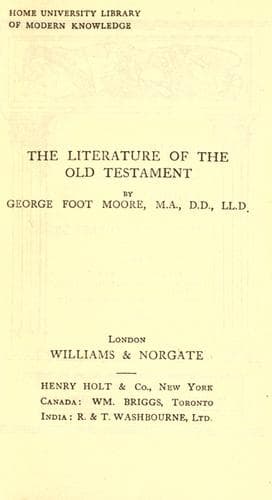
The Literature of the Old TestamentMoore, George Foot
Religion
The Literature of the Old Testament
Moore, George Foot
Bible. Old Testament -- Introductions
One peculiarity of the Book of Daniel remains for brief mention. Like
Ezra, it is in two languages: Dan. i. 1-ii. 4 is in Hebrew, from ii. 4
b to the end of c. 7 in Aramaic, and from the beginning of c. 8 the
rest is in Hebrew again. The Aramaic begins appropriately where the
Chaldæans (diviners) are introduced speaking in what the author
evidently conceives to be the language of the country; the text does
not, however, revert to Hebrew when this conference is over, but holds
on, not only through all the rest of the stories, but through the
first vision (c. 7). A motive for just this distribution of the two
tongues is not discoverable; in the chapter of accidents are various
possibilities which offset one another. As in Ezra--though there are
some differences between the two books--the Aramaic is of a kind which
was vernacular in Palestine in the last centuries before our era.
CHAPTER XX
MINOR PROPHETS
The Minor Prophets--so called not in depreciation, but because their
books are smaller than those of Isaiah, Jeremiah, and Ezekiel--form in
the Jewish Bible one book, in which are brought together oracles in
the name of various prophets from the eighth century B.C. (Amos,
Hosea) to the fifth (Haggai, Zechariah), and one anonymous book
(Malachi). As in the collections which bear in their titles the names
of Isaiah and Jeremiah, so in the collection of the Twelve, prophecies
have been attributed, by error or conjecture or accident, to prophets
to whom they do not belong, and additions and alterations have been
made by compilers or editors. The extent of this alien matter differs
in different books; Hosea, for example, seems to contain little of it,
while in Micah it is considerable.
HOSEA.--In our Bibles, in which the Minor Prophets stand and are
counted individually, the first is Hosea. This position, which it has
also in the Hebrew Bible, may have been given the book, partly on
account of its age, partly on account of its length; but it might also
claim it by reason of its worth, for Hosea is one of the greatest of
the prophets, not in Minor company alone, but in the canon. No other
contributed so much, through his own words and through his great
successors, Jeremiah and the Deuteronomists, to deepen and
spiritualize the conception of religion.
Hosea was an Israelite who began to prophesy to his countrymen in the
reign of Jeroboam II., probably about 750 B.C., and after Jeroboam's
death witnessed at least the beginning of that procession of
assassinations and revolutions through which the kingdom hurried to
meet its fate; but it does not appear from his book that he lived to
see the invasion of Tiglath-Pileser and the loss of Gilead and Galilee
in 734 B.C. in which his own predictions of impending doom had so
signal a verification. Their complete fulfilment came in 721, when
Sargon made an end forever of the kingdom of Israel, and deported many
of the people of Samaria to remote quarters of his empire.
Public-domain text, read in full here on John Shaqi.
Reviews
Reviews
No reviews yet
Be the first to share your thoughts on this work.
Elsewhere in the archive
Join the Discussion
Join the discussion
Sign in to leave a comment or review.
Sign InorCreate an account