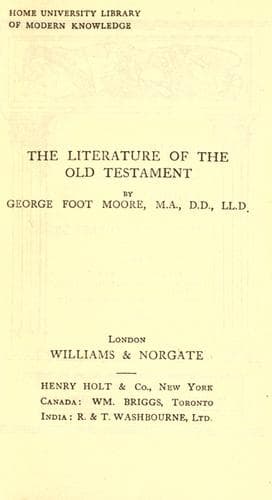
The Literature of the Old TestamentMoore, George Foot
Religion
The Literature of the Old Testament
Moore, George Foot
Bible. Old Testament -- Introductions
Habakkuk 3, entitled "A Prayer by Habakkuk the Prophet," with a
musical direction following, as in the Psalms, is in fact a psalm, and
the presence of the musical directions, implying liturgical use,
suggests that it once stood in a hymn book like the Psalter. It is a
fine ode, by an author well read in the classic literature of his
nation. The theophany (iii. 2 ff.) is indebted to Exod. xxxiii. 2 ff.
and Judg. v. 4 ff. The ode belongs with the Psalms of the Persian
period. It is imitated in Ps. 77. The title ascribing it to Habakkuk
the prophet is of no greater authority than the ascription Pss.
146-148 in the Greek Bible to Haggai and Zechariah.
ZEPHANIAH.--The pedigree of Zephaniah is carried back to his
great-great-grandfather, Hezekiah. As such genealogical proper names
have seldom more than three terms, it has been conjectured that the
particular reason for adducing two extra generations here was that the
prophet boasted royal blood--Hezekiah was the king of that name. The
thing is possible, though the generations are somewhat rapid; the
parallel royal line counts four. It would be a romantic touch if the
prophet was a great-grand-nephew of Manasseh, and a second cousin of
Josiah, of the manners and morals of whose courts he has so bad an
opinion.
The title says that he prophesied in the reign of Josiah, and with
this the tenor of a large part of the book agrees. Like the earliest
prophecies of Jeremiah (Jer. 1-6) Zephaniah's Day of the Lord is
inspired by the irruption of the Scythian hordes which threatened to
engulf the civilized nations of western Asia in a common ruin, as the
Mongol and Turkish hordes, pouring out of the same cradle of the
commissioned races, the scourges of God, did successively in later
ages. For Judah it is the day of reckoning for the sins which made the
reign of Manasseh a by-word with prophets and historians, and which
went on unrestrained through the short years of his successor and the
minority of Josiah down to the reforms of his eighteenth year. Nowhere
is the state of things in that three quarters of a century more
clearly exposed than in the first oracle of Zephaniah.
Public-domain text, read in full here on John Shaqi.
Reviews
Reviews
No reviews yet
Be the first to share your thoughts on this work.
Elsewhere in the archive
Join the Discussion
Join the discussion
Sign in to leave a comment or review.
Sign InorCreate an account