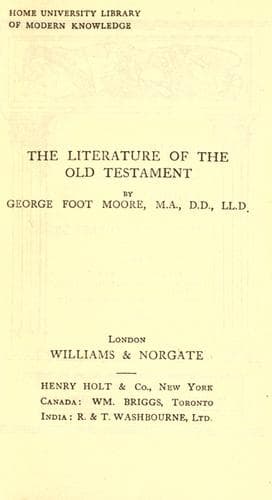
The Literature of the Old TestamentMoore, George Foot
Religion
The Literature of the Old Testament
Moore, George Foot
Bible. Old Testament -- Introductions
At the end of this group of visions is a bit of history of high
interest. A crown was made of gold and silver brought by some
representatives of the Babylonian Jews, and set by the prophet on the
head of Zerubbabel, who was saluted as "the Scion," i.e., the Messiah
(Jer. xxiii. 5), with the prediction that he should rebuild the
temple, assume majesty, and sit and rule upon his throne. The
coronation, it need hardly be said, was in the secrecy of a private
house, and is to be regarded as a symbolical act; the Babylonian
envoys kept the crown as a memento. But its significance is
unmistakable.
The prediction was not fulfilled. Whatever became of Zerubbabel--he
disappears with this scene--he never wore a real crown nor sat upon
the throne of his fathers. This has led to more than one change in the
text, which, however, as in many other cases, were not sufficiently
thorough-going to pass unnoticed. First, the crown is once made
plural, "crowns," as though the intention was to crown both the prince
and the priest; when it comes to the coronation, however, only Joshua,
the high priest, receives the honour (vi. 11). But vss. 12, 13^a,
which are left untouched, can refer only to Zerubbabel. Verse 13^b
originally read, "and [Joshua] shall be priest _at his right hand_ (so
the Greek Bible, instead of "on his throne"), and there shall be
harmony between the two." In vs. 14 there is only one crown.
In Zech. 7 the question is asked of the prophet by some pilgrims from
Bethel, whether, now that the temple was rebuilding, they should
continue to keep the fast for the burning of the temple in the fifth
month; his response, that what God wants of them is not fasting but
justice, charity, compassion, that none should oppress his neighbour
nor devise evil against him, is quite in the spirit of the earlier
prophets to whom he appeals.
He goes on, in c. 8, to picture the coming golden age, when the fasts
shall all be turned into cheerful feasts, a prophecy which is one of
the finest of its kind in the Old Testament and a fitting crown to the
book.
The prophecies of Zechariah (cc. 1-8) are definitely dated; they
spring out of a definite historical and religious situation which is
everywhere apparent and consistent. Not so the chapters which follow
(cc. 9-14). The titles (ix. 1; xii. 1) have a different form
("Burdens"), the situations which give their background to the oracles
are wholly unlike that which stands out so clearly in Haggai and
Zechariah; the character of the prophecies, with their affected
obscurity, easily penetrable, doubtless, to contemporaries, but
impenetrable to us who have not the historical key, and their
apocalyptic eschatology, are in strong contrast to the manner of
Zechariah; the evidence of diction confirms that of situation and
content.
Public-domain text, read in full here on John Shaqi.
Reviews
Reviews
No reviews yet
Be the first to share your thoughts on this work.
Elsewhere in the archive
Join the Discussion
Join the discussion
Sign in to leave a comment or review.
Sign InorCreate an account