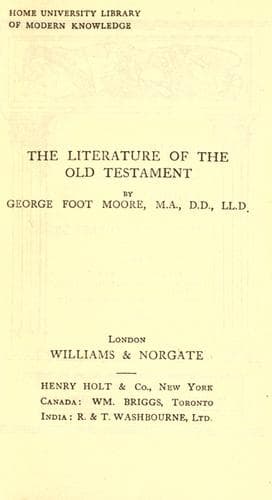
The Literature of the Old TestamentMoore, George Foot
Religion
The Literature of the Old Testament
Moore, George Foot
Bible. Old Testament -- Introductions
There are, however, other and more conclusive criteria than references
to historical events or persons. The religious situation in the Jewish
community reflected in very many of the psalms is that of the Persian
and Greek period, not that of the days of the kingdom. The strife of
parties or of classes, on one side the righteous, the pious, the poor,
for whom the psalmists speak, on the other, the wicked, the ungodly,
the rich and the great; here those whose delight is in the law of God
(religion), there those who contemn it and pursue evil ways regardless
of its precepts and prohibitions, is a new condition, not in the
behaviour of the wicked, but in the self-consciousness of the pious,
who feel themselves a distinct class and are evidently crystallizing
into a party or a sect.
The religious conceptions and the conception of religion are drawn
chiefly from Jeremiah and the Deuteronomists, and from Isaiah 40 ff.,
but on the subjective side of religion, piety, the best of the psalms
represent a more advanced stage than the prophets of the seventh and
sixth centuries. The hopes of the future of God's people and of the
world run with the prophets of the Persian period and the contemporary
anonymous and editorial additions to the older prophetic books. That
the long rehearsals of the ancient history like Pss. 78, 105, 106, or
eulogies of the law such as Ps. 119, or litanies of the fashion of
Ps. 136, belong to a stage in the history of the liturgy such as
rouses the enthusiasm of the Chronicler is also apparent. The evidence
of language tends the same way. Fine hymns were written even at a late
time; but on a large part of the psalms the decadence has set its
mark.
Such is the impression the Psalter makes as a whole, and it indicates
that not only is the existing collection late, but that most of the
hymns in it were comparatively modern when they were brought together.
This is what would be expected in a hymn book, which for devotional
even more than for liturgical use, needs to express and nurture the
type of piety prevalent in its own time and circle. Protestant hymn
books fifty years ago, outside the Anglican communion, had hardly any
hymns in them more than a couple of hundred years old, except
versified translations of the psalms, modernized and Christianized in
the operation.
It would be going much beyond the evidence to say there were no psalms
in the Psalter that were composed in the days of the kingdom; there
may be a considerable number. But the proof that any particular psalm
came from that period is difficult and seldom very convincing. This is
true even of the psalms which speak of the king; for, aside from the
impossibility of deciding in some instances whether a reigning king is
meant or the king of the good time coming (Messiah), a foreign king
may sometimes be in mind (Ps. 45 is so interpreted by many), or an
Asmonæan king.
Public-domain text, read in full here on John Shaqi.
Reviews
Reviews
No reviews yet
Be the first to share your thoughts on this work.
Elsewhere in the archive
Join the Discussion
Join the discussion
Sign in to leave a comment or review.
Sign InorCreate an account