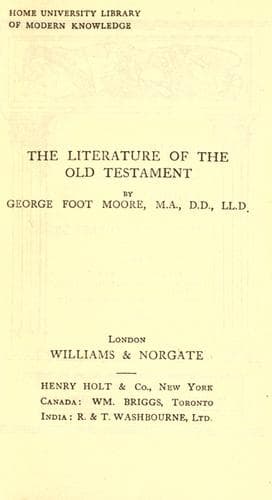
The Literature of the Old TestamentMoore, George Foot
Religion
The Literature of the Old Testament
Moore, George Foot
Bible. Old Testament -- Introductions
The characteristic interests of the author and his highly
characteristic style sharply distinguish his own writing from the
sources which he incorporates. These sources, as will be supposed,
were of different kinds and of various worth; they were naturally not
the same in all parts of the long period he covers, and he has not
always dealt with them in the same way. Part of his material comes,
directly or indirectly, from the annals of the kings, to which the
reader is regularly referred for further information (see e.g., 1
Kings xiv. 19, 29), or from temple records; part of it from more
properly literary sources. Sometimes it has all the marks of
trustworthy tradition originating close to the event; again, it is
embroidered with legendary traits; a smaller part is edifying fiction.
In some cases, as in the stories of Elijah and Elisha, a special
source is recognizable, but in the main the attempt to trace the
literary channels through which the matter reached the author is
fruitless.
In the history of Solomon's reign the central place is taken by a
description of the palace and temple he erected (1 Kings 6-7), for
which c. 5 is a preparation, and c. 8, the dedication of the temple,
the sequel. The interesting account of the provincial organization and
system of taxation in c. 4 is evidently from an authoritative source;
the cession of cities in Galilee to Hiram, the list of cities
fortified, the (mutilated) account of the revolt of Edom, the rise of
the kingdom of Damascus, and the (mutilated) history of the revolt of
Jeroboam, the prelude to the separation of Israel and Judah, are also
of good authority.
By the side of these are stories celebrating the magnificence and
wisdom of Solomon, the beginnings of the exuberant Solomonic legend.
The judgment of Solomon in the case of the two harlots and of the
visit of the Queen of Sheba are examples of the popular tale, and
relatively old. The dedication of the temple has been much expanded by
the author of the Book of Kings; 1 Kings viii. 14-66 are wholly his
composition; ix. 1-9 is an appendix to c. 8. In viii. 1-12 an older
account of the dedication has been improved by various hands.
Comparison with the Greek translation shows that this process went on
to very late times; the latest additions are akin to the priestly
stratum in the Pentateuch. Chapter xi. 1-13 also is by the author of
the Book of Kings, built about a few words from his source in vs. 7;
vss. 29-40 are of the same sort.
Public-domain text, read in full here on John Shaqi.
Reviews
Reviews
No reviews yet
Be the first to share your thoughts on this work.
Join the Discussion
Join the discussion
Sign in to leave a comment or review.
Sign InorCreate an account