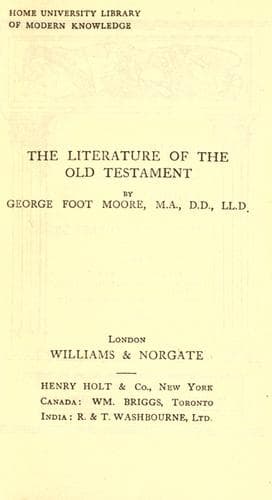
The Literature of the Old TestamentMoore, George Foot
Religion
The Literature of the Old Testament
Moore, George Foot
Bible. Old Testament -- Introductions
The conflict between the tribes to whom the name Israel by historical
right belonged, headed by Ephraim, intent on reclaiming the ancient
liberties which Solomon had curtailed and securing adequate guarantees
for them, and Rehoboam, obstinate to maintain the despotism which his
father had established and the supremacy of Judah, ended in the
Israelite tribes refusing to acknowledge the succession and setting up
a kingdom of their own with Jeroboam the son Nebat as king. These
critical events are narrated in the source, 1 Kings xii. 1-20, with
noteworthy impartiality; a comparison with the treatment of the matter
by the author of the Book of Kings himself in xi. 29-39; xii. 21-24,
is instructive. The account of Jeroboam's religious foundations and
innovations in c. xii. 26-33 (with which xiii. 33^b belongs) is
probably based on an old Israelite source (the temples Jeroboam built,
etc.), on which the author of the book has put his own construction
and made his own comments. 1 Kings 13 is a specimen of the edifying
stories--religious fiction--which were added to the historical books
at a very late time and are especially numerous in Chronicles; the
reference to it in 2 Kings xxiii. 17 f. is an interpolation in a
context itself post-exilic. The story of the visit of Jeroboam's wife
to the prophet Ahijah (1 Kings xiv. 1-18) is in the manner of the
author, but seems to have an older basis. The fluid state of the text
at a very late time is again shown by the fact that in some recensions
of the Greek version the story is not found in this place, but,
together with other matter about Jeroboam (in part variant parallel to
1 Kings xi. 26 ff., 40), in a long passage which stands in c. 12
between vss. 24 and 25.
The invasion of Shishak, king of Egypt (1 Kings xiv. 25-28), is
introduced by the author with a catalogue of the deuteronomic
transgressions which provoked God to punish the kingdom in this way;
the similarity to the introduction to the oppressions in Judges is
apparent. So in the following chapters: the author's facts probably
come from annalistic sources which can in places be recognized, but
the religious interpretation of the events, which he sometimes gives
in his own quality as historian, sometimes puts into the mouth of a
prophet (e.g. xvi. 1-7, cf. xiv. 1-18), is from the point of view of
the deuteronomist school.
Public-domain text, read in full here on John Shaqi.
Reviews
Reviews
No reviews yet
Be the first to share your thoughts on this work.
Elsewhere in the archive
Join the Discussion
Join the discussion
Sign in to leave a comment or review.
Sign InorCreate an account