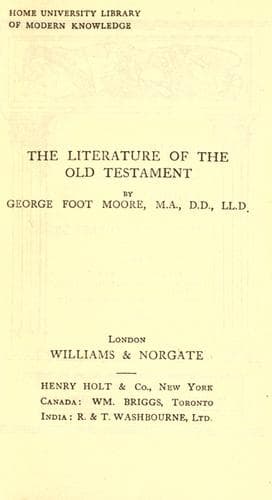
The Literature of the Old TestamentMoore, George Foot
Religion
The Literature of the Old Testament
Moore, George Foot
Bible. Old Testament -- Introductions
Another characteristic of the author's method is illustrated by his
treatment of the reign of Omri (1 Kings xvi. 23-28). Omri was the
founder of the greatest dynasty of the northern kingdom, and was one
of its greatest kings. From an inscription of the Moabite king Mesha,
we learn that Omri subjugated the lands east of the Jordan (see also 2
Kings i. 1; iii. 4 ff.), and it is probable that his conquests were
pushed to the north-east into Syria; the Assyrian kings long after his
death call Israel the "house of Omri." But the long and brilliantly
successful reign of a king who in religion followed in the footsteps
of the kings of Israel before him, "golden calves" and all, obviously
could not be made to exemplify the doctrine that such sins are
regularly visited by condign judgment in national disaster.
Consequently, all that our author records of Omri, beyond the
revolutions which paved for him the way to the throne (1 Kings xvi.
16-18), is contained in one verse, 1 Kings xvi. 24--he built a capital
on a new site, Samaria!
In the following reign, however, Israel had troubles enough; the
conquests east of the Jordan were lost, and the long chapter of Syrian
wars began. This was material more to the author's purpose, and he
makes good use of it. Here also, in addition to the annals and
whatever other sources were at his hand for the preceding period, he
had a new and peculiarly grateful source in the stories of Elijah and
Elisha. To the fact that these prophets were outstanding figures in
some of the crises of the Syrian wars we owe it that so much of the
history of that struggle is preserved; for what the author has
extracted from the annals is as meagre as elsewhere.
From such "lives and times" of the prophets is derived much the
greater part of 1 Kings 17-2 Kings 10, with 2 Kings xiii. 14-21. The
stories of Elijah (1 Kings 17-19; 21; 2 Kings 1; ii. 1-18) are among
the most striking in the Old Testament; the supernatural in them seems
the natural setting for a figure of such heroic mould, and is a
stronger testimony than any record of fact could be to the impression
of the superman on the imagination of ordinary mortals. Through the
vesture of legend, we too have the impression of a something titanic
in the man who dared solitary to stand for his God against kings,
priests, prophets, and people, and, worse than all, the vengeful fury
of a woman! We can see, also, that his conflict against the prophets
of Baal makes an era in the history of religion in Israel. "If Jehovah
be God, follow him; but if Baal, then follow him," he thunders at the
people on Mt. Carmel. It was not the first assertion of the jealousy
of Jehovah and the exclusiveness of the true religion; but the issue
had never before been so dramatically joined. The intolerant
monotheism of Judaism had found its war cry.
Public-domain text, read in full here on John Shaqi.
Reviews
Reviews
No reviews yet
Be the first to share your thoughts on this work.
Elsewhere in the archive
Join the Discussion
Join the discussion
Sign in to leave a comment or review.
Sign InorCreate an account