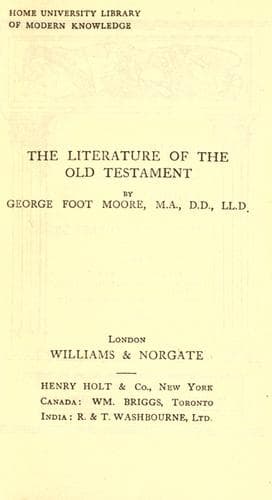
The Literature of the Old TestamentMoore, George Foot
Religion
The Literature of the Old Testament
Moore, George Foot
Bible. Old Testament -- Introductions
In the following reigns the material derived from narrative sources is
more scanty; a noteworthy passage of this kind is the account,
evidently from an Israelite writer, of the chastisement Jehoash of
Israel inflicted on the presumptuous Amaziah of Judah (2 Kings xiv.
8-14). The contemporary reigns of Jeroboam II of Israel and Azariah,
or Uzziah, of Judah, lasting half a century, a period of great
prosperity in both kingdoms, are dispatched with extreme brevity, and
are followed by the swiftly successive conspiracies and revolutions in
which the northern kingdom declined to its fall. The story of treason
and bloodshed is suspended to tell of the reign of Ahaz in Judah (2
Kings 16) from a source chiefly interested in the temple, and then the
last act of Israel's tragedy opens. To the brief account of the fall
of Samaria in 2 Kings xvii. 1-6, is appended the moral of the whole
history, VSS. 7-41. This homiletic improvement of the catastrophe was
an inviting task, and besides the author of Kings, the exilian
continuator and perhaps still later editors contributed to draw it out
and emphasize it.
From this point the historian has only Judah to deal with. The reign
of Hezekiah is narrated at some length in 2 Kings 18-20. A
considerable part of these chapters (xviii. 13-XX. 19) is found also
in the Book of Isaiah (Isa. 36-39), with variations which are of much
interest for the history of the text. The psalm, Isa. xxxviii. 9-20,
for instance, is not found in Kings; 2 Kings xviii. 14-16 is not in
Isaiah, and minor differences occur in almost every verse. The
introduction to the reign of Hezekiah by the author of Kings is
somewhat longer than usual, and attributes to him not only the
destruction of the serpent idol in the temple which Moses was
believed to have made (cf. Num. xxi. 8 f.), and of other apparatus of
heathenism, but the removal of the high places, making him thus
anticipate the reforms of Josiah a century later (2 Kings xviii. 4).
This probably exaggerates Hezekiah's good works, but for the bronze
serpent to which sacrificial worship had been paid from time
immemorial, as well as for vs. 7 f. (Hezekiah's rebellion), which is
the antecedent of vs. 13 ff., he may have had the authority of the
annals.
Public-domain text, read in full here on John Shaqi.
Reviews
Reviews
No reviews yet
Be the first to share your thoughts on this work.
Elsewhere in the archive
Join the Discussion
Join the discussion
Sign in to leave a comment or review.
Sign InorCreate an account