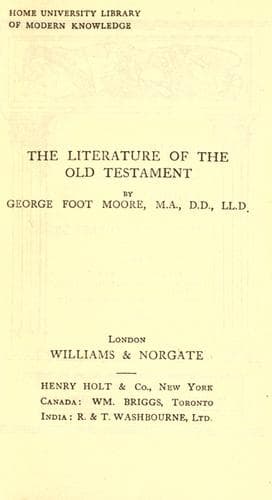
The Literature of the Old TestamentMoore, George Foot
Religion
The Literature of the Old Testament
Moore, George Foot
Bible. Old Testament -- Introductions
From the annals probably come also 2 Kings xviii. 13-16, with their
brief record of the penalty Hezekiah paid for his revolt. Of this we
have also Sennacherib's account in his inscriptions, where he tells
how he took the cities of Judah and shut up Hezekiah in Jerusalem
"like a bird in a cage," and gives the figures of the heavy indemnity
he imposed upon him. There follow two longer accounts of Sennacherib's
operations, 2 Kings xviii. 17-xix. 8 and xix. 9-37, which are commonly
regarded as parallel and somewhat discrepant relations of the same
campaign, but by some are thought to refer to two different occasions,
at an interval of ten years or more. 2 Kings xx. 1-11 (cf. Isa. 38) is
perhaps from a life of Isaiah, who is the chief figure in it; vs.
12-19 (Isa. 39), the embassy of the chronic Babylonia rebel, Merodach
Baladan, presumably to undermine Hezekiah's shaky loyalty to his
Assyrian lord, seems to belong at an earlier point in the story; in it
also Isaiah is the central person. In the closing paragraph the
author of Kings has preserved an interesting annalistic notice of an
aqueduct and reservoir which Hezekiah constructed, not improbably the
Siloam tunnel and the reservoir it feeds.
Of the fifty-five years' reign of Manasseh, and the two years of his
son Amon, a half-century of peace and prosperity in which the country
recuperated from the disasters Hezekiah had brought upon it, nothing
is told. Instead we have a long catalogue of Manasseh's religious
obliquities, which includes all the crimes most abhorrent to the
seventh-century prophets and laws, and the proclamation of God "by his
servants the prophets" that these sins sealed the doom of Judah. This
prediction is made from the standpoint of the accomplished fact, and
indeed most of the chapter seems to be by the exilian continuator of
Kings or a still later writer.
With the reforms of Josiah (621 B.C.; 2 Kings 22-23) we arrive at
events which, if not within the personal knowledge of the author of
Kings, were known to his older contemporaries. This does not, of
course, exclude the use of written records or narratives, and, in
fact, there seem to be traces of such in the chapters. More certain it
is that the continuator of the book made some changes in the account;
the oracle of Huldah, for example, seems to have been revised in the
light of the event.
To this continuator, as has already been said, the history of the two
sieges of Jerusalem, the deportations, and the misfortunes of those
who were left in the land are to be attributed. In several places in
earlier parts of the history we have had occasion to observe that
additions and changes continue to be made by the editors or
scribes--and every scribe who copied a book in those days wielded an
editor's pen when he chose--until a time close to the age of the Greek
translation, that is, the third century B.C.
Public-domain text, read in full here on John Shaqi.
Reviews
Reviews
No reviews yet
Be the first to share your thoughts on this work.
Elsewhere in the archive
Join the Discussion
Join the discussion
Sign in to leave a comment or review.
Sign InorCreate an account