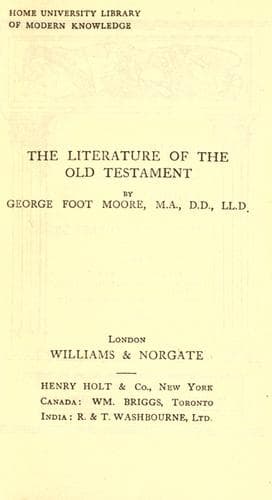
The Literature of the Old TestamentMoore, George Foot
Religion
The Literature of the Old Testament
Moore, George Foot
Bible. Old Testament -- Introductions
The age in which the Pentateuch and the several Historical Books
(Joshua-Kings), the product of the long and obscure process which we
have attempted to outline in the preceding chapters, were adjusted and
connected so as to make a continuous history from the creation to the
fall of the Judæan state, can be fixed only by the fact that the
author of Chronicles (about 300 B.C. or somewhat later; see below)
seems to have read these books in the order and, so far as his use of
them permits a judgment, substantially with the contents of our
present Old Testament. This arrangement, or edition, if we choose to
call it so, as has been shown, did not put an end to additions and
alterations, though they gradually became less frequent and less
important in the following centuries. A standard and stable Hebrew
text was established only in the second century after the Christian
era.
CHAPTER XII
CHRONICLES
By the side of this comprehensive history stands another which is in
part parallel, in part supplementary, to it, Chronicles-Ezra-Nehemiah.
It differs from the former in being the work of one author, whose
characteristic conceptions, interests, and manner make it easy to
distinguish his writing from the sources he incorporates. His
peculiarities are the better known because there is so much of his own
in the books--not far from half the matter contained in them.
The succession of the high priests is brought down to Jaddua, who was
contemporary with Alexander the Great, and lists of heads of priestly
and levitical families are given in Neh. 12 for the reign of Darius
(Codomannus), the last Persian king. The book can, therefore, not be
put much, if any, before 300 B.C., and more probably it was written in
the following century.
The history begins with the death of Saul and the election of David as
king by all Israel at Hebron (1 Chron. 10-11). The preceding chapters
are filled with genealogies, beginning with Adam. Twenty-six verses
bring us to Abraham, and the second chapter opens with the sons of
Israel, while the third is a list of the sons of David and of his
successors on the throne to the fall of the kingdom, with the
descendants of the last king through several generations. These
genealogies, to which historical notices of different kinds are
frequently attached, are in part compiled from various places in the
Pentateuch and Historical Books, in part more freely reproduced from
such passages; but a large remainder has no parallel in the older
work. The author, here as elsewhere, evidently attaches great
importance to these lists, in particular to those which enabled the
families of his own time, clerical and lay, or the inhabitants of
towns and villages, to trace their pedigree back to remote times.
Public-domain text, read in full here on John Shaqi.
Reviews
Reviews
No reviews yet
Be the first to share your thoughts on this work.
Elsewhere in the archive
Join the Discussion
Join the discussion
Sign in to leave a comment or review.
Sign InorCreate an account