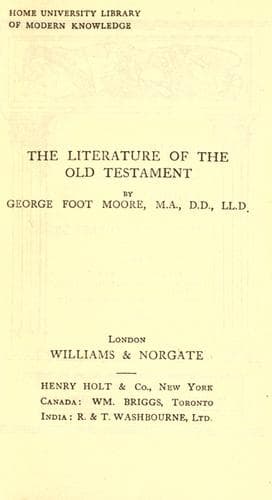
The Literature of the Old TestamentMoore, George Foot
Religion
The Literature of the Old Testament
Moore, George Foot
Bible. Old Testament -- Introductions
The Book of Esther, it was long ago observed, is singular among the
books of the Bible in that there is no mention of God in it. It is
Jewish with a sanguinary loyalty to race, but of Judaism as religion
there is not a trace; it is in fact somewhat obtrusive by its absence.
When Mordecai warns Esther that if she fails her people in their hour
of need deliverance will come "from another place," the word God is
ostentatiously avoided; before her great adventure she fasts three
days, but there is no suggestion of prayer; in the celebrations of
rescue and the annual commemoration of it there is feasting and
gladness, but no thanksgiving to God. It is no wonder that orthodox
rabbis doubted the inspiration of so conspicuously secular romance,
nor that the Greek translators made good the religious deficiencies of
the book by putting pious prayers into the mouth of Mordecai and
Esther at the appropriate junctures.
The age of the book cannot be very closely determined; it is pretty
certainly not older than the third century B.C., more likely from the
second. A note at the end of the Greek version says that this
translation was brought from Jerusalem to Egypt in the year which
corresponds to 114 B.C. The earliest mention of the festival of Purim
is in 2 Macc. xv. 36, where it is called Mordecai Day.
RUTH.--The story of Ruth is laid in the time of the Judges, for which
reason it was placed in the Greek Bible and in modern versions between
Judges and Samuel. It tells of a young Moabitess, the childless widow
of a Judæan from Bethlehem, who accompanies her widowed mother-in-law
back to Bethlehem, embracing her religion. Ruth goes out to glean
after the reapers and by chance comes to the field of Boaz, a kinsman
of her husband, who shows her kindness. By Naomi's contrivance, she
reveals to him who she is under circumstances that appeal to his
chivalry, and, after a nearer of kin has waived his right, Boaz takes
the widow with the land, and they live happy ever after. Their son
Obed is David's grandfather. The legal proceedings in the last chapter
are different from anything we otherwise know of Israelite custom, but
our ignorance is no warrant for assuming that the usage there
described is fictitious.
If the story of Esther is told with dramatic power, that of Ruth is
told with idyllic grace. The pathos of the moment in which Naomi bids
her daughters-in-law return to their mothers' homes and Ruth refuses
to part from her is unforced. The picture of the gleaners in the
fields; the delicacy with which the night at the threshing-floor is
treated; the scene at the city gate, where the waiver and redemption
are witnessed and the shoe given in attestation; the blessing of the
townsmen on the union, all have the charm of simple and unaffected
narrative.
Public-domain text, read in full here on John Shaqi.
Reviews
Reviews
No reviews yet
Be the first to share your thoughts on this work.
Elsewhere in the archive
Join the Discussion
Join the discussion
Sign in to leave a comment or review.
Sign InorCreate an account