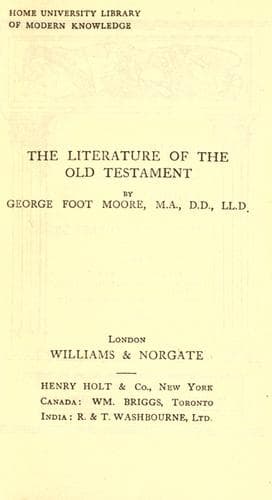
The Literature of the Old TestamentMoore, George Foot
Religion
The Literature of the Old Testament
Moore, George Foot
Bible. Old Testament -- Introductions
The same phenomenon appears on a smaller scale in Isa. 1-12. That
these chapters, at one stage in the history of the collections, formed
a roll by themselves is probable from the fact that they begin with a
grand overture (c. 1), in which the leading motives of Isaiah's
prophecy are heard, and close (c. 12) with a psalm of praise for the
messianic deliverance which is the subject of c. 11. But the order of
the prophecies is not chronological: the inaugural vision and Isaiah's
call to be a prophet stands, not at the beginning, as in Jeremiah and
Ezekiel, but in c. 6 (dated in the year of King Uzziah's death), while
the chapters that precede it (cc. 2 f.; 5), with what was once an
initial title (ii. 1), may confidently be assigned, on internal
grounds, to the reigns of Uzziah's successors. Chapters 7 and 8 (dated
under Ahaz) seem to have originally followed close on c. 6, as they do
now. Whatever may be the reason for this singular arrangement, it
seems evident that the compiler had several smaller groups or loose
leaves of oracles, which he put together for better preservation,
rather, perhaps, by affinity of subject than in order of time.
This must have taken place at a comparatively late time, for not only
does his roll begin with a prophecy (Isa. i. 2-9) which vividly
depicts the devastation of Judah and the isolation of Jerusalem by
Sennacherib in 701 (perhaps the latest oracle of Isaiah preserved in
the book), but it contains passages (e.g. xi. 11-16) which bear all
the marks of a time several centuries after Isaiah's death; the psalm
in c. 12 is perhaps later still. Another indication that the
collection was made at a date remote from the age of the prophet is
the fragmentary character of several of the oracles in cc. 2-5. The
refrain verses here afford a certain clue; they show that prophecies
originally composed with much art in balanced strophes with closing
refrains came into the compiler's hands mutilated and dislocated.
Thus, v. 25 has the refrain of ix. 8-21; x. 4, while x. 1-3 is a "woe"
which has strayed away from v. 18 ff., and the refrain ii. 9, 11, 17
recurs in v. 15.
Fragmentary as many of these prophecies are, enough remains to show
that Isaiah had poetical genius as well as unequalled mastery of the
peculiar literary form of the Hebrew oracle. The parable of the
vineyard (Isa. v. 1-7), or the picture of the swift, resistless
advance of the Assyrian (v. 26-30), or the description of devastated
Judah (i. 2-8), or the oracle against Samaria (ix. 8-21), in the
authorized English Version illustrate in different ways the art with
which Isaiah handles this traditional form.
Public-domain text, read in full here on John Shaqi.
Reviews
Reviews
No reviews yet
Be the first to share your thoughts on this work.
Elsewhere in the archive
Join the Discussion
Join the discussion
Sign in to leave a comment or review.
Sign InorCreate an account