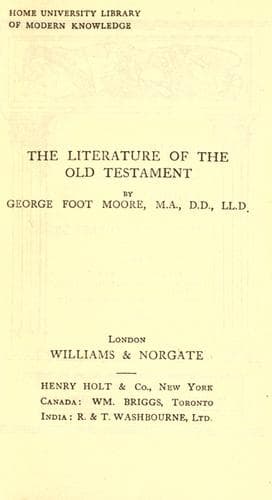
The Literature of the Old TestamentMoore, George Foot
Religion
The Literature of the Old Testament
Moore, George Foot
Bible. Old Testament -- Introductions
Between the two, in the two years of suspense, when about his own
people the prophet is dumb, is placed the group of prophecies against
foreign nations (cc. 25-32), beginning with oracles against the
neighbours of Judah who held true to Nebuchadnezzar in this crisis and
had their reward at Judah's cost--Ammonites, Moabites, Edomites, and
Philistines. These are followed by long predictions of the ruin of
Tyre, over whose calamity the prophet exults more loudly than the
grievance of Jerusalem (Ezek. xxvi. 2) seems to justify.
Nebuchadnezzar did in fact besiege Tyre for thirteen years (585-572
B.C.), and doubtless inflicted upon it great losses; but the island
city, with its command of the sea, he could not take. Ezekiel himself,
in a remarkable passage which is perhaps his latest word in the book,
admits that his predictions of the capture of Tyre (xxvi. 7-14) had
not been fulfilled--Nebuchadnezzar had had to raise the long and
ineffectual siege--but he promises that Jehovah will reward him for
these fruitless labours in the Lord's service by giving him Egypt
instead (xxix. 17-21). The animosity against Egypt which finds
expression in the predictions of the Babylonian subjugation of that
country is more easily explained. Egypt had been the evil genius of
Judah, instigating rebellion against the Babylonian suzerainty, and
promising armed aid which always failed in the decisive hour; it was
meet that it should taste the cup of humiliation itself. In c. 32 the
descent of Egypt to the hell of fallen nations is vividly depicted; a
similar picture of the descent of the Babylonian king in Isa. 14 has
already been noted. Not improbably Babylonian notions of the nether
world may have influenced the imagery of both, as a myth of paradise
seems to have suggested the imagery of Tyre in Eden (xxviii. 12 ff.).
Outside this group is an oracle against Edom (c. 35), and the great
prophecy of the irruption of Gog and his hordes and their fate (cc.
38 f.).
A conspicuous feature of the Book of Ezekiel are the extended visions
and the elaborated symbolical actions. In the inaugural vision (Ezek.
i.-iii. 15), for instance, God appears, a veritable _deus ex machina_,
on a high seat in a curious motor car made up of animated wheels and
winged monsters. In a later vision (c. 10) he sees God leave the
doomed temple in Jerusalem and mount this cherubim car, in which he is
whirled away through the air to the east; and in the great vision of
the new temple in the golden age God returns to his abode in the same
conveyance (c. 43). Striking examples of symbolical actions may be
found in Ezek. 4, and in xii. 1-20. They are of such an extraordinary
character as to raise the question whether they were really enacted
before the eyes of the people or only described in discourse.
Public-domain text, read in full here on John Shaqi.
Reviews
Reviews
No reviews yet
Be the first to share your thoughts on this work.
Elsewhere in the archive
Join the Discussion
Join the discussion
Sign in to leave a comment or review.
Sign InorCreate an account