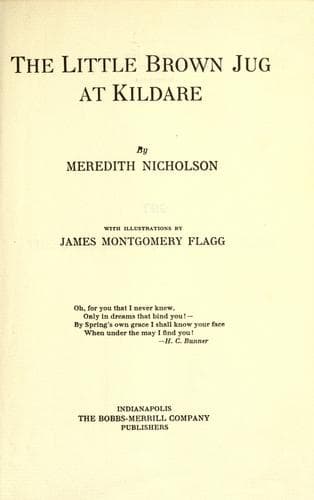
The Little Brown Jug at KildareNicholson, Meredith
General
The Little Brown Jug at Kildare
Nicholson, Meredith
Fathers and daughters -- Fiction; Governors -- Fiction; Humorous stories; North Carolina -- Fiction; South Carolina -- Fiction
Caboose 0186, with three box-cars and a locomotive attached, lay in the
southeastern yards at Raleigh late in the evening of the same day. In
the observatory sat Mr. Thomas Ardmore, chatting with the conductor,
while they waited for the right of way. Mr. Ardmore's pockets were
filled with papers, and he held half a dozen telegrams in his hand. The
freight cars behind him were locked and sealed, and a number of men
lounging near appeared to be watching them.
The reply of the sheriff of Dilwell County had precipitated the crisis.
That official succinctly replied to Ardmore's message:
Be good and acquire grace.
While this dictum had aroused Miss Dangerfield's wrath and indignation,
it calmed her fellow conspirator, and for hours Ardmore had poured forth
orders by telegraph and telephone. No such messages as his had ever
before radiated from Raleigh. The tolls would have bankrupted the
commonwealth if Ardmore had not cared for them out of his private purse.
His forester, with an armed posse from Ardsley, was already following
the streams and beating the brush in search of Appleweight. One car of
Ardmore's special train contained a machine gun and a supply of rifles;
another abundant ammunition and commissary supplies, and the third cots
and bags. The men who loafed about the train were a detail of
strike-breakers from a detective agency, borrowed for the occasion.
Cooke, the conductor of the train, had formerly been in the government
secret service, and knew the Carolina hill country as he knew the palm
of his hand. Ardmore had warned his manager and the housekeeper on his
estate to prepare for the arrival of Mrs. Atchison, whose private car
had come and gone, carrying Miss Geraldine Dangerfield on to Ardsley.
Ardmore had just received a message from his sister at some way station,
reporting all well and containing these sentences: "She is rather
different, and I do not quite make her out. She has our noble
brother-in-law a good deal bewildered."
Cooke ran forward for a colloquy with the engineer over their orders;
the guards climbed into one of the box-cars, and the train moved slowly
out of the Raleigh yards to the main line and rattled away toward
Kildare, with Mr. Ardmore, pipe in mouth, perched in the caboose cupola.
A caboose, you may not know, is the pleasantest place in the world to
ride. Essentially a thing of utility, it is not less the vehicle of joy.
Neither the captain of a trading schooner nor the admiral of a canal
fleet is more sublimely autocratic than the freight conductor in his
watch-tower. The landscape is disclosed to him in leisurely panoramas;
the springs beneath are not so lulling as to dull his senses. If he
isn't whipped into the ditch by the humor of the engineer, or run down
and telescoped by an enemy from behind, he may ultimately deliver his
somber fleet to its several destinations; but he is the slave of no
inexorable time-table, and his excuses are as various as his cargoes.
Public-domain text, read in full here on John Shaqi.
Reviews
Reviews
No reviews yet
Be the first to share your thoughts on this work.
Elsewhere in the archive
Join the Discussion
Join the discussion
Sign in to leave a comment or review.
Sign InorCreate an account