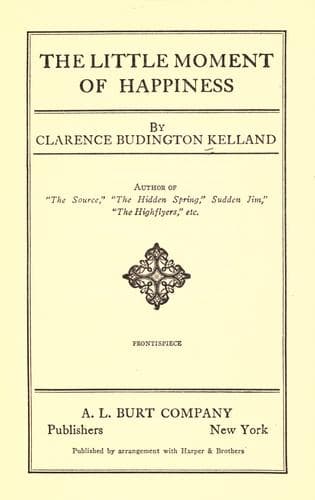
The Little Moment of HappinessKelland, Clarence Budington
General
The Little Moment of Happiness
Kelland, Clarence Budington
Man-woman relationships -- Fiction; World War, 1914-1918 -- Fiction
“One mus’ theenk not about the sad theengs,” said Madeleine,
sententiously. “One mus’ be happy. That ees best. Me—I take what
comes.... See, I am ver’ ol’. _Oui...._ I am twenty-four. So ol’ am I
that no man ever want to marry me.... _Tiens!_ I am _passée_. But still
I laugh.... I love Monsieur Bert, and I am happy. One day Monsieur Bert
love me no more....” She shrugged her shoulders. “Then I am sad for
leetle w’ile.... But another yo’ng man he will love me, perhaps. It ees
so. What would you?... If one does not love and is not loved, then there
is no happiness, _n’est-ce pas_?...”
Andree nodded. “When there is no love it is terrible,” she said.
Bert laughed and looked at Kendall. “Aha!” he said. “But, mademoiselle,
Ken says you and he do not love each other—that you are just
_camarades_....”
“It was so,” she said, “but now”—she looked at Kendall gravely—“it is so
no longer. No.... We love.”
“I said to you,” Madeleine addressed Kendall, “that French girls are not
cold. Did I not?”
“But—” Kendall began to expostulate and to explain.
But Madeleine would have none of it. “You are ver’ _sérieux_, monsieur.
Doubtless you are also _un religieux_!”
“_Religieux?_ What is that?”
“She means in English a monk,” said Andree, her eyes twinkling. “To wear
a brown robe—_oui!_—and also bare feet and sandals.”
“It must be.” Madeleine laughed delightedly. “For heem to look at a
yo’ng girl ees a sin.... See!... See!... He makes to blush. Regard his
ear!...”
Andree laughed quietly, meantime studying Kendall’s face with kindly,
twinkling eye. She did not deride him, but one could see that she loved
to tease him—this incomprehensible foreigner who was so _drôle_!
Kendall laughed, too, a bit ruefully, but while he laughed he was
thinking, fumbling for Madeleine’s point of view. It was clear to him
that the man who was not eager for love could be no man at all—but a
monk. It was the only possible explanation. Love was for men and women;
continence was for monks. Well, then? To love might be a sin for a monk,
but even on this point she doubtless was lenient; for a man not to love
was a sin. He was not realizing his duty to achieve happiness. Love was
love. It was good. It carried no burden of evil.
“The good God—He make the yo’ng man and the yo’ng girl, and He tell them
to love.... It is true. Then one must obey the good God,” she said,
seriously.
Here was rather a new religion to Kendall, but, somehow, it did not seem
absurd, nor did her utterance of it touch upon the sacrilegious. She
made the statement simply, out of her heart, with simple belief.... He
turned to Andree.
“Is that what you think?” he asked.
“Of a certainty—or why did the good God create men and women and
love?... I theenk God is happy when He sees a yo’ng man and a yo’ng girl
who love each other much.”
“Some philosophy!” said Bert. “I’m for it.”
“But the love—it ees _nécessaire_....”
Public-domain text, read in full here on John Shaqi.
Reviews
Reviews
No reviews yet
Be the first to share your thoughts on this work.
Elsewhere in the archive
Join the Discussion
Join the discussion
Sign in to leave a comment or review.
Sign InorCreate an account