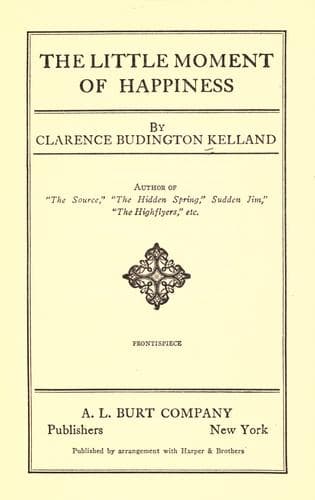
The Little Moment of HappinessKelland, Clarence Budington
General
The Little Moment of Happiness
Kelland, Clarence Budington
Man-woman relationships -- Fiction; World War, 1914-1918 -- Fiction
“Can you not see it? To-day you—you are very charming, but you are
merely you. You have nothing, you are nothing. You have a room, perhaps,
for which you pay seventy francs a month. Am I not right? You are not
happy. You are hidden.... But then comes a wonderful night. You make the
great success. Paris is at your feet. Paris adores you.... What does it
mean? Ah, mademoiselle, one can scarcely imagine it. It means a career,
a great success in life. It means to be adored, to have all that a
beautiful woman can desire.... It means applause and the envy of all the
world—everything! everything!... What a change! What a wonderful
change!”
“Yes,” she said, her eyes glowing.
“It means that famous men will compete for your favor. You will be
pointed out everywhere, received everywhere.... The papers will speak of
your every movement.... You will be happy.”
“Yes,” she said.
Then his manner changed, his enthusiasm seemed to die, and he looked
steadily into her face.
“But before it all comes one must enter the _Académie_.”
“It is so.”
“Mademoiselle, do you want very much to do so?”
“Oh, greatly! greatly!”
“Then it shall be. I guarantee it.”
“Oh, monsieur!”
He leaned over the table, his face serious now, his handsome eyes eager.
“If mademoiselle will be kind,” he said.
She looked at him an instant and let her eyes fall.
“Ah,” she said.
“I love you.... I adore you.”
“No,” she replied, with the merest hint of a smile. “It is not so. You
do not love me.”
“You are very lovely.... You are poor—you shall be rich. You are
unknown—you shall be famous.... And I love you.”
She did not lift her eyes now, but sat very still and looked at her
plate. Her face told him nothing; it had not altered its expression of
detached gravity—and it intrigued him, made her the more desirable
because he could not understand her. Her lips quivered, she closed her
eyes and drew a little breath which was almost a sigh.
“It cannot be, monsieur.”
He sat erect, astonished, really astonished.
“You—you refuse?”
“Yes, monsieur.”
“You refuse fame and wealth and all that may be yours?”
“It is necessary, monsieur.”
“And why? Why?”
“Because, monsieur, I love, and I am happy.... I am faithful.... I am
very happy.”
He stared, unbelieving. Then, “It is the American officer—this Capitaine
Ware?”
“Yes, monsieur.”
“You—you throw it all away for him—for this foreigner? You throw away
your chance—your career?... It is absurd, impossible!... But look,
mademoiselle. These Americans they do not remain. There is the war.
To-morrow, the next day, he may be ordered away—he may be sent back to
America.... He will go away from you and leave you lonely.... For a
week, a month, will you throw away your life? Oh, mademoiselle, think!
It would be terrible.”
Public-domain text, read in full here on John Shaqi.
Reviews
Reviews
No reviews yet
Be the first to share your thoughts on this work.
Elsewhere in the archive
Join the Discussion
Join the discussion
Sign in to leave a comment or review.
Sign InorCreate an account