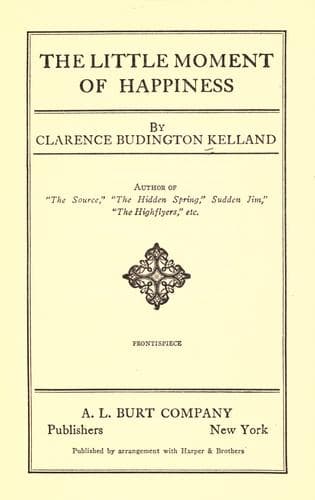
The Little Moment of HappinessKelland, Clarence Budington
General
The Little Moment of Happiness
Kelland, Clarence Budington
Man-woman relationships -- Fiction; World War, 1914-1918 -- Fiction
Bert could never understand the effect of the sight of Paris on his
friend. Of course it was a regular city, different from New York and
Chicago, but there was no use to rave about it or to stand on a bridge
mooning and looking at a row of buildings. Paris meant a good time of an
exotic sort to Bert—and that was all. He was willing to agree that the
town was beautiful if anybody insisted, but what was the use of
insisting? A town was a town. It wasn’t what a town looked like that
made it a good place to be; it was the business opportunities of the
town and the opportunities for pleasure when business was over for the
day. He went with Kendall to see Notre Dame, and wondered why in the
dickens anybody had ever gone to the trouble to hew all those ugly
carvings out of stone, or why they should run fringes of them around a
church. It was a sort of dingy old place, anyhow.... Now for a regular
building, give him the Hôtel de Ville. That was something like, because
it might have been the post-office or a railroad station in New York. He
would have traded his chance to see all the ramshackle cathedrals in
France for one sight of the Woolworth Building. Now there was something!
There was some use in going to see that structure! It was capable of
astonishing him—but only because it was so lofty. To see it of a spring
morning with the hazy sun tipping its golden peak meant nothing to him
except looking at a tall building early in the day.... There wasn’t a
high building in Paris! But Ken wanted to poke around to see such things
as Notre Dame, and if he got pleasure out of it, that was his business.
Nevertheless, Bert saw dimly that Kendall had something admirable which
was denied to him. Not that he wanted it especially! He was very well
satisfied, but somehow he admired Ken for having it and liked him the
better for it.... And Ken was always philosophizing about things, and
advancing theories, and worrying about morals, and splitting hairs of
right and wrong. To Bert certain things were wrong, and the rest didn’t
matter. It was wrong to murder and to steal or to kick a child or to
cheat at cards or in any other game. As for the bulk of the rest of the
possible acts of man, he saw them as neuter, and not mattering much....
But Ken could get up a moral argument over the way he spread his bread!
And these arguments had the power to upset his friend completely, to
make him gloomy, to worry him.... It was utter nonsense, but it was a
part of Ken and Ken was his friend.
Public-domain text, read in full here on John Shaqi.
Reviews
Reviews
No reviews yet
Be the first to share your thoughts on this work.
Elsewhere in the archive
Join the Discussion
Join the discussion
Sign in to leave a comment or review.
Sign InorCreate an account