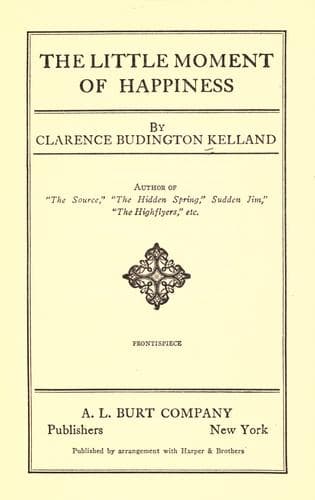
The Little Moment of HappinessKelland, Clarence Budington
General
The Little Moment of Happiness
Kelland, Clarence Budington
Man-woman relationships -- Fiction; World War, 1914-1918 -- Fiction
respectable in all France—all save the numerous soft-voice girls who
threaded their way in and out.... And for a mere child, a girl who
seemed hardly in her teens, who bit and struggled in the hands of two
gendarmes, shrieking in a voice that remained long in Kendall’s ears, “I
have the age!... I have the age!... I have the age!...” over and over
again....
Madeleine had laughed and shrugged her shoulders with some flippant word
of comment, but Kendall looked down at Andree to see her eyes moist and
big with pity.
“_Pauvre p’tite!... Pauvre p’tite!..._ It is not she who should be
punish’. She have made no wrong.... I theenk it is the crime of poverty.
_N’est-ce pas?_ Oh, to be _pauvre_—it is not well....”
“Yet _le bon Dieu_ permits it,” said Madeleine.
“_Non!... Non!..._ It is not of God, ma’m’selle; it is of man—thees
poverty and thees awful theengs.... It mus’ be that tears come often to
the eyes of the good God....”
Kendall was affected deeply. She spoke of the good God with such
simplicity, with the sort of intimacy which children use. He felt almost
a reverence for her.... There was a _rightness_ about her, a simple,
unaffected, unconscious _goodness_, that set her apart and made her
different, to him, from all mankind.
“_Mignonne!_” he whispered, and pressed her arm, and she, looking up
shyly into his face, gave answering pressure, and, perhaps, wondered a
little.
She was always so, never changing, yet always possessed of that infinite
variety of which Shakespeare speaks. But it was a variety which was
always Andree. In no mood, in no manifestation, could she be anything
but Andree. If she were sad, it was with a sadness peculiar to her, and
very lovable; if she were gay, it was with her own gaiety; if she were
mischievous, it was with a charming impishness which no other being
could have managed. And always she was natural—as natural as the rain
that falls or the sun that shines or the breezes that blow.... She was
Andree.
“To-morrow is the great fête,” said Andree. “There will be much to see.”
“And I can’t show it to you. I must work in the morning, and in the
afternoon I am ordered to go to the front.”
“How long?” she said, quickly.
“But one day. I shall be here again Sunday—and we shall play, eh? We
shall have _déjeuner_ together and do something in the afternoon, and
find a place to dine....”
“It is well—but you mus’ be ver’ careful. You mus’ not let the _boche_
keel you.... Oh, I should be sad, sad.”
Public-domain text, read in full here on John Shaqi.
Reviews
Reviews
No reviews yet
Be the first to share your thoughts on this work.
Elsewhere in the archive
Join the Discussion
Join the discussion
Sign in to leave a comment or review.
Sign InorCreate an account