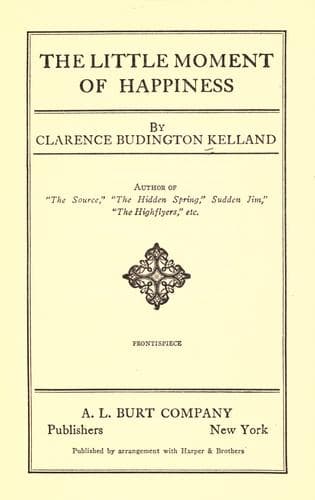
The Little Moment of HappinessKelland, Clarence Budington
General
The Little Moment of Happiness
Kelland, Clarence Budington
Man-woman relationships -- Fiction; World War, 1914-1918 -- Fiction
Presently the road sank below the level of the fields. The car was
running between irregular rows of barely discernible lights which
appeared to issue from the ground—as indeed they did—glowing from the
dugouts of French artillerymen who had burrowed into the banks at the
side of the road. The moon began to climb so that objects became dimly
visible. The scene was like that of some village of prehistoric
cave-dwellers, save for those breaks in the line of dugouts, cunningly
covered with nets of camouflage, under which lurked the cannon, muzzles
directed toward the foe.
Now they stopped in a battered, deserted village which was headquarters
of our Twenty-eighth Infantry, a component of that First Division made
up of our old regulars—a body of troops whose name will be famous as
long as the history of America shall endure. And there, in an enormous
dugout entered through a narrow tunnel some fifty feet in length, Ken
found shelter for the night. He traversed the tunnel, descended steps
carved out of the stone to a level twenty feet below, and found himself
in a warren. Here, notwithstanding the hour of the night, were bustle
and activity. Here were offices where sounded the click of typewriters
and the staccato of the telephone; here were passages, bedrooms, a
dining-room—a veritable maze hewn out of the chalk formation. It was as
if Ali Baba’s forty thieves had turned systematic and were carrying on
their trade according to modern business methods. Yet men worked here as
casually and nonchalantly, accustomed by long habit, as they would have
worked in their New York offices....
Kendall was provided with a cot, and, despite the sounds that penetrated
here, the sounds of the Fourth of July celebration of the First
Division, he slept....
Early in the morning he awoke, then, after some hours spent with the
regimental intelligence officer, he walked abroad to see this historic
countryside. Far off to the left the glasses showed him that spot which
had been Montdidier; almost straight ahead was the grisly, silent
crumble known now to the world by the name of Cantigny.
Public-domain text, read in full here on John Shaqi.
Reviews
Reviews
No reviews yet
Be the first to share your thoughts on this work.
Elsewhere in the archive
Join the Discussion
Join the discussion
Sign in to leave a comment or review.
Sign InorCreate an account