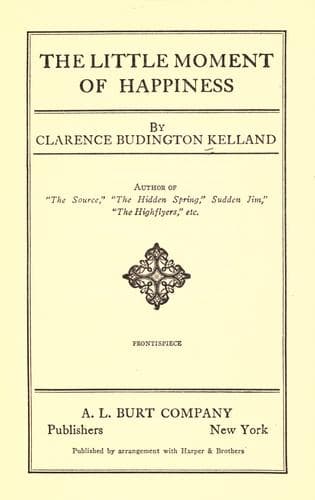
The Little Moment of HappinessKelland, Clarence Budington
General
The Little Moment of Happiness
Kelland, Clarence Budington
Man-woman relationships -- Fiction; World War, 1914-1918 -- Fiction
“_Non, non, non!..._” She was laughing now. “Maybe one leetle
theenk—only. But I—oh, I have theenk of you ver’ much. I have theenk you
are _pas fidèle_.”
“I!... Not faithful!”
“Yes.” She nodded her head decidedly.
“Why do you say that? You know I am _fidèle_.”
“I have see’ you.”
“Seen me—where?”
“Oh, you are ver’ wicked.... You deceive me mos’ cruel.” He could not
tell if she were serious or if she were teasing him. “Also I am mos’
_jalouse_. It is thees yo’ng girl—thees yo’ng American girl. I have see’
you with her las’ night.”
“Oh yes. We had dinner together. She has just come back to Paris for a
day or two.”
“Oh yes,” she mimicked. “I know thees leetle dinner. She tries to steal
you away from me.... You like her more than me. It is so. I see it.... I
shall take me a dagger and make her to die—so.” She laughed gaily.
“You don’t really believe I’m unfaithful at all. You’re just making fun
of me.”
“Did you bring her _here_?”
“Eh?... What’s that? Here? Maude Knox here?”
“And why not? Since you are not _fidèle_.”
“But you don’t understand. Maude Knox is an American girl. She
wouldn’t—I couldn’t—”
“Oh, it is so?... Then these American girls, they do not love. They are
stone or wood, is it so?... I do not onderstan’ these American girls.”
She was delightfully disgusted. “Sometime I shall cross the ocean to
observe these girls. It will be ver’ droll. America mus’ be a ver’
droll, ver’ serious country—where the girls do not love.”
“They do love. Of course they love.”
“Well, then, Why do you make such astonishment when I speak that she
comes here?”
He waggled his hand helplessly, and she, perceiving that she was teasing
him, put on greater pretense of seriousness.
“Ah, I see,” she said. “The American girl she say, ‘I love,’ and then
she enter into the convent.... She goes in the _jardin_ and see the bud
about to blossom, and she cover it weeth a veil. Is it not? Oh, such
love as thees! It is the love of the ice for the snow.”
“It’s different, Andree. I can’t explain it to you because I can’t
explain it to myself.”
“_Pouf!_ Different! Do you theenk I cannot perceive it is different? Oh
yes, monsieur. I perceive ver’ clearly ... the difference between alive
and dead.”
“You’re wrong. American girls can love—”
“How do you know?” she interrupted, impishly.
“—can love,” he persisted, “but all nice American girls marry—”
“To be sure. Ah, marriage—that is ver’ well. There is nothing against
marriage. Not in the least. Many people marry, and it is ver’ well. Why
not?...”
“I never can make you understand.”
“Nevair.... I cannot to onderstan’ what is not natural. Do you
onderstan’ if you see the river ron up the hill? _Mais non._ To love is
to love; to marry is to marry. It is not the same theeng altogether....”
“America is different.”
Public-domain text, read in full here on John Shaqi.
Reviews
Reviews
No reviews yet
Be the first to share your thoughts on this work.
Elsewhere in the archive
Join the Discussion
Join the discussion
Sign in to leave a comment or review.
Sign InorCreate an account