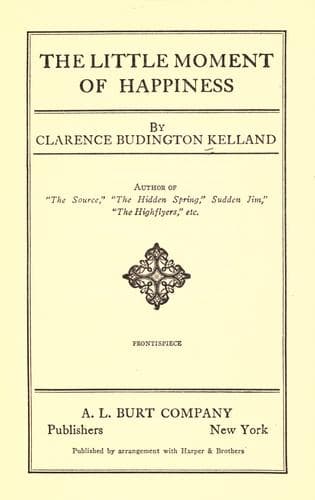
The Little Moment of HappinessKelland, Clarence Budington
General
The Little Moment of Happiness
Kelland, Clarence Budington
Man-woman relationships -- Fiction; World War, 1914-1918 -- Fiction
The bell interrupted his moral reflections and he hurried to the door
with that thrill of anticipation which Andree’s arrival always
caused.... There she stood, very straight and still and grave, just as
he knew she would be. She raised her eyes to his exactly as he knew she
would raise them, and smiled appealingly. He drew her inside, into his
arms.
“I’ve been needing you, _mignonne_,” he said. “Everything goes wrong
when you’re not with me.”
“I am here,” she said, brightly. “Behol’! all is now well. I shall let
nothing trouble you.”
“Do you love me?”
“Yes.... And you?”
“You are very beautiful.”
“That is well.... No, I am not beautiful, but it is well you theenk it
is so. I am happy.”
She regarded him solicitously. “You are ver’ tired. Have you work’
_beaucoup_? It is not that you have an illness?”
“No.... No. Everything is all right now that you are here. You are the
only person who is _right_ in the whole world.”
“Oh!... Oh!... I am ver’ wonderful! I do not know thees till I meet you.
I theenk I am only a yo’ng girl, but behol’! I have ver’ suddenly
become—how do you say?—The _dictionnaire_—queek. The _dictionnaire_!”
Laughing gaily, she searched with ludicrous haste for the word and could
not find it. “Oh, it is terrible! W’at I am I cannot say. I am something
that ees not in the _dictionnaire_. To be a thing that is not in the
_dictionnaire_ is mos’ grand and étonnant—astonishing. I shall to be
ver’ vain.”
Her eyes were dancing with an impish light. She seemed very young, a
child, endowed with some magical quality which reassured him, dispelled
the heaviness which rested on him.
“Have Monsieur Bert and Mademoiselle Madeleine yet arrive’?”
“They’re in the _salon_.”
“Come. We shall see them—now.” Again that quaint gesture of poking
downward at the floor with a slender finger. “Thees minute.”
The girls shook hands formally and lapsed into an amazing splutter of
French. Ken looked from one to the other, from Andree, tiny, fragile,
dark, elfin, to Madeleine, tall, slender, fair of hair, always laughing.
Madeleine seemed nothing but embodied laughter; Andree seemed to him now
as she always seemed to him, a mystery, incomprehensible—a being come to
him out of a land of wonders.
“Bert is going away,” he said.
“For how long?”
“Three weeks.”
“Oh, it ees a lifetime. Mademoiselle will be ver’ sad.”
“She says not,” Ken said.
“It is not possible. She will be mos’ sad.”
“Not Madeleine,” said Bert. “She’s going to find another American
officer to keep her happy while I’m gone.”
“But she could not—_non, non!_ You do not theenk!”
Madeleine laughed gaily.
“What would you do if I went away for three weeks?” Ken asked.
“You do not go!... It ees not true.” Her eyes grew big and her lips
parted as she waited for his answer.
“No, I’m not going any place.... But if I should go, what would you do?”
“I should be ver’ _solitaire_. Ver’ often I should weep. And I should
work ver’ hard at all times—to make the days go more fast.”
Public-domain text, read in full here on John Shaqi.
Reviews
Reviews
No reviews yet
Be the first to share your thoughts on this work.
Elsewhere in the archive
Join the Discussion
Join the discussion
Sign in to leave a comment or review.
Sign InorCreate an account