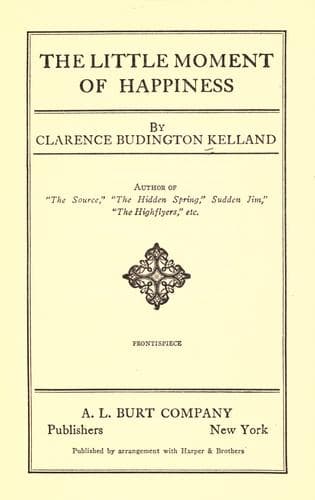
The Little Moment of HappinessKelland, Clarence Budington
General
The Little Moment of Happiness
Kelland, Clarence Budington
Man-woman relationships -- Fiction; World War, 1914-1918 -- Fiction
True, she was of broad mind, and her life abroad had enabled her to
perceive and to understand many matters which are obscure in America.
These she could understand and condone or pronounce to be good and even
virtuous—when they did not touch her directly. They were all right for
others, but—but when they entered her own life that made of it another
matter.
If she had been told that in a time past Kendall Ware had carried on an
affair with a French girl—an affair that was wholly of the past—she
might have dismissed it after small bitterness and have accepted him
without more than a slight question. But this was present, going on
under her eyes. She saw the workings of it, and saw that he actually
loved this girl. That it was the sort of love he would one day give to
his wife she did not believe. That did not seem possible to her.... On
the other hand, there were many periods when she knew a fear that
Kendall would marry Andree. She asked herself why he should not marry
Andree. She had seen the girl, talked with her, found her beautiful and
sweet—even good. Maude even felt a sympathy for Andree to the extent of
warning Kendall against tampering with the girl’s happiness. Her
sympathies were with Andree rather than with Kendall. She had never
experienced the slightest aversion for Andree, none of that aversion
which a woman safe in the possession of what she terms her virtue is
entitled by ruthless custom to feel for the girl who is no longer a
maid. She was able to conceive of a union such as Andree’s with Ken as
possessing a sort of regularity, as being made more or less regular by
the standards and conceptions of the society in which they were
living.... But, nevertheless, when it came to marrying Ken her American
prejudices and conceptions took on life and set themselves up as a
barrier.
It was natural that she should be very curious about Andree and should
wish the opportunity of meeting and studying the girl. She was rather
frank and outspoken herself and could imagine herself discussing the
situation with this girl and, perhaps, arriving at some determination.
But the opportunity failed to present itself for days and weeks. Her
brief chat with Andree on Bastille Day had proved nothing, and it was
not until early August when a chance meeting in the Galeries Lafayette,
where both girls happened to be shopping, gave her the opportunity she
desired.
They met on one of the broad winding stairways of that enormous store,
Andree descending, Maude ascending. Of the two Andree was the more
self-possessed. She looked at Maude with that quaintly inquiring
expression with which she seemed to greet all the world, but gave no
other sign of recognition until Maude smiled and extended her hand.
“_Bon jour, mademoiselle_,” she said.
“_Bon jour_,” responded Andree.
“I’ve been hoping to see you for a long time. We hardly got acquainted
in that little chat we had a month ago.”
“You are sure you wish to be acquainted?”
“Oh, very.”
“_Pourquoi?_”
Public-domain text, read in full here on John Shaqi.
Reviews
Reviews
No reviews yet
Be the first to share your thoughts on this work.
Elsewhere in the archive
Join the Discussion
Join the discussion
Sign in to leave a comment or review.
Sign InorCreate an account