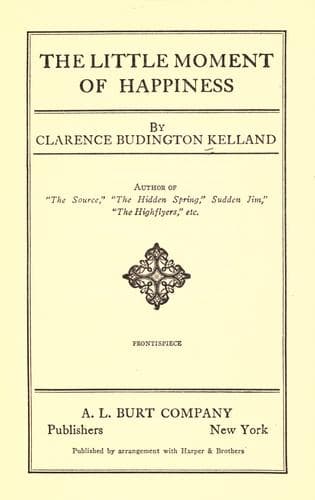
The Little Moment of HappinessKelland, Clarence Budington
General
The Little Moment of Happiness
Kelland, Clarence Budington
Man-woman relationships -- Fiction; World War, 1914-1918 -- Fiction
Now that it reached the point of discussing Kendall, Maude was
nonplussed for a moment. How should she open the discussion, if
discussion there were to be? What could she say that would not be an
impertinence to this girl, whom, somehow, she did not want to offend?
Maude even respected her, perceived that about Andree which demanded
respect and consideration. She hesitated. Andree smiled and leaned a bit
forward.
“Mademoiselle,” she said, “perhaps it is that you are in love with thees
yo’ng man also. Is it of that you wish to speak?”
“I am not in love with him, mademoiselle.”
“Ah ... but that is not the ver’ truth—no. I have seen. I do not
know—maybe you theenk you do not love him, but you do love him. That is
why I am willing to speak weeth you.”
“I don’t understand.”
“I am willing to speak weeth you about Monsieur Ware bicause I love him
ver’ much and bicause you also love him. I theenk it mus’ be bicause I
know we both wish ver’ much to have him always be happy. Is it not?”
“But I do not love him.”
“Then, mademoiselle, it is not of a necessity for us to speak at all. If
you are merely his frien’, his acquaintance, you have no right to speak
weeth me about him. It is so. _Mais_, if you love him”—she lifted her
shoulders—“that is ver’ different.”
“He has not asked me to love him.”
“That is well. I theenk he loves me very _fidèle_. Yes. But also he
theenk of you ver’ much. I have seen. You are of his country and are
ver’ pretty. He theenk of you and compare you weeth me. I am French....
That is not American. He theenk about w’en he goes back to America, and
then bicause I am ver’ French and not American he is troubled. He theenk
I do not onderstan’, but I onderstan’ ver’ well. He say that he love
Andree in Paris, and in Paris Andree is ver’ nice, but in America, where
all is so different, then he does not know what to theenk.”
“And then?”
“And then he theenk of you, mademoiselle, of you who would not be
foreign and strange and at whom his friends would not make to shrug
their shoulder’ and lift the eyebrow’—bicause I do not know the manner
and the custom.”
“Is that all that troubles you—not knowing the manners and the customs?”
“What else could there be, mademoiselle? I am not _très-jolie_—ver’
beautiful—but also I am not so hideous. I do not know.”
Maude shifted the subject because she was not ready to speak about the
thing which would be troublesome more than manners and customs.
“Has he asked you to go to America with him?”
“No, mademoiselle. We have not speak of that.”
“But you would go? You would leave your France and your people and go to
a strange land?”
“I theenk, mademoiselle, that I would leave the worl’ for Monsieur
Ware.”
“As his wife?”
“As to that, I do not care. If he wish, then ver’ well. If he do not
wish, then ver’ well, also. The marriage—makes nothing to us. It is only
the love.... But you, mademoiselle, you make of marriage the necessity.”
“I would not marry him—I do not think I would marry him.”
Public-domain text, read in full here on John Shaqi.
Reviews
Reviews
No reviews yet
Be the first to share your thoughts on this work.
Elsewhere in the archive
Join the Discussion
Join the discussion
Sign in to leave a comment or review.
Sign InorCreate an account