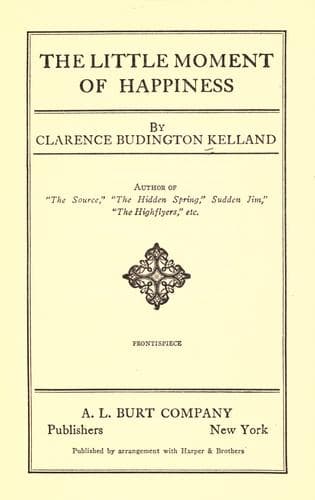
The Little Moment of HappinessKelland, Clarence Budington
General
The Little Moment of Happiness
Kelland, Clarence Budington
Man-woman relationships -- Fiction; World War, 1914-1918 -- Fiction
But Ken noticed that every minute or so Bert strolled with elaborate
nonchalance to the window and looked down the street. Ken smiled. Bert’s
manner was not that of a man whose heart suffers, but who has taken an
injury to his pride....
“Here comes Andree,” said Bert.
Ken did not go to look, as he usually did. It was not that he did not
want to see Andree, but her arrival brought his affairs to the acute
stage. He had put off and put off the struggle to reach a decision; had
occupied his mind with other matters, crowding out as much as was
possible any thoughts of Andree and of what he was going to do about
her. True, the thing had been with him always, lurking in the background
and ready to step out at the least encouragement. But he had not
approached it directly. It had been a sort of dull ache that he was
always conscious of, but which he had been able to stifle. Now she was
coming, was almost at the door. It would be a matter of minutes only
before he would have to tell her that he was going away.... Even now he
did not admit to himself that he had reached a partial decision, indeed
that he had not required to make a decision upon one point. That was
taking her with him. He had told himself that it would be possible to
marry her and to take her on the transport that carried him, but it was
self-deception, and he knew it was self-deception. In his heart he knew
now, as he had known, that to-night he would say good-by to Andree and
go to America without her.... He might come back for her, might even
marry her before he went away, to have her follow him on another vessel.
But there would be a parting, temporary or permanent....
He had never asked himself if Andree would marry him. The idea that she
would not do so had never entered his head, which was significant. It
was that which made his decision doubly difficult, for she was wholly in
his hands, had given herself to him to do with as he pleased, and her
life was his to break if he wished to do so.... He persuaded himself
that his hesitation was more on her account than his own, that it would
be impossible for her to be happy in the conditions which would be found
in America, or that perhaps it would be impossible. He believed that he
was trying to decide what would be best for her—or almost believed it.
It may be that he was not wholly selfish, not thinking solely of himself
and of the effects of his marriage with Andree upon himself. At any
rate, his anxiety for her was very real and very disturbing.
Public-domain text, read in full here on John Shaqi.
Reviews
Reviews
No reviews yet
Be the first to share your thoughts on this work.
Elsewhere in the archive
Join the Discussion
Join the discussion
Sign in to leave a comment or review.
Sign InorCreate an account