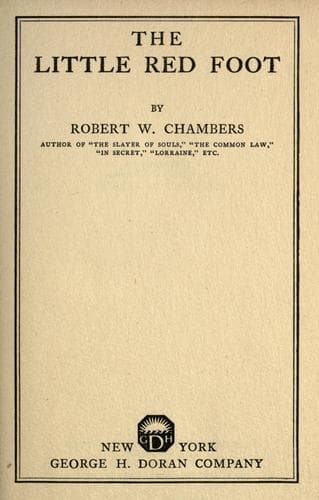
The Little Red FootChambers, Robert W. (Robert William)
History
The Little Red Foot
Chambers, Robert W. (Robert William)
New York (State) -- History -- Revolution, 1775-1783 -- Fiction
I could not read what was writ, for the writing was in strange signs and
figures; so presently I gave over trying and looked up at my prisoner,
who now had dressed again.
"You are Captain Moucher?"
He denied it hoarsely; but I, having now no vestige of doubt concerning
this miserable man's identity, ignored his answer.
"What is this paper which was taken from your boot?"
He seemed to find no word of explanation, but breathed harder and
watched my eyes.
"Is it writ in a military cipher?"
"I do not know."
"How came these papers in your boot?"
He stammered out that somebody who had cleansed his boots must have
dropped them in, and that, in pulling on his boots that morning, he had
neither seen nor felt the papers.
"Where did you dress this morning?"
"At the Johnson Arms in Johnstown."
"You wear the uniform of an officer in the Canajoharie Regiment. Are you
attached to that regiment?"
He said he was; then contradicted himself, saying he had been obliged to
borrow the clothing from an officer because, while bathing in the Mohawk
at Caughnawaga, his own clothing had been swept into the water and
engulfed.
Over this lie he was slow in speech, and stammered much, licking his dry
lips, and his reddish, furtive eyes travelling about him as though his
stealthy mind were elsewhere.
"Do you recollect that we supped in company at Johnson Hall--you and
I--and not so long ago?" I demanded.
He had no remembrance.
"And Lieutenant Hare and Captain Watts were of the company?"
He denied acquaintance with these gentlemen.
"Or Hiakatoo?"
Had never heard of him.
I bade Joe lay more dry wood on the fire and kick it well, for the
sphagnum moss still dulled it. And, when it flared redly, I rose and
walked close to the prisoner.
"What are you doing here?"
He had merely come out of curiosity to see the camp at Summer House.
"In disguise?"
He had no other clothing, and meant no harm. If we would let him go he
would engage to return to Albany and never again to wear any clothing to
which he was not entitled.
"Oh. Who was your mate there in the orchard, who also wore the
Canajoharie regimentals?" I demanded.
An acquaintance made en passant, nothing more. He did not even know his
name.
"I'll tell you his name," said I. "That man was Lieutenant Hare. And you
are Captain Moucher. You are spies in our camp. We've taken you; we
ought to take him before midnight.
"The paper I have of you is writ in British military cipher.
"Now, before I send you to Colonel Dayton, with my report of this
examination, what have you to confess that I might add to my report, in
extenuation?"
He made no answer. Presently a fit of ague seized him, so that he could
scarce stand. Then he reeled sideways and, by accident, set foot in the
live coals. And instantly went clean crazed with fright.
As the Oneida caught him by the shoulder, to steady him, he shrieked and
cowered, grasping Joe's arm in his terror.
Public-domain text, read in full here on John Shaqi.
Reviews
Reviews
No reviews yet
Be the first to share your thoughts on this work.
Elsewhere in the archive
Join the Discussion
Join the discussion
Sign in to leave a comment or review.
Sign InorCreate an account