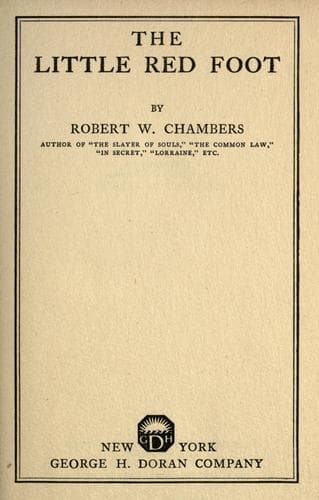
The Little Red FootChambers, Robert W. (Robert William)
History
The Little Red Foot
Chambers, Robert W. (Robert William)
New York (State) -- History -- Revolution, 1775-1783 -- Fiction
My sojourn at the Wells house was brief; the family was evidently very
anxious but not gloomy; even the children smiled courageously when I
made my adieux; and my dear little friend, Janet, led me by the hand to
the edge of the brush-field, through which I must travel to regain the
forest, and kissed me at our parting.
On the wood's edge, I paused and looked back at the place called Cherry
Valley, lying so peacefully in the sunshine, where in the fields grain
already was turning golden green; and fat cattle grazed their pastures;
and wisps of smoke drifted from every chimney.
That is my memory of Cherry Valley in the sunny tranquillity of late
afternoon, where tasseled corn like ranks of plumed Indians, covered
vale and hillock; and clover and English grass grew green again after
the first haying; and on some orchard trees the summer apples glimmered
rosy ripe or lush gold among the leaves;--ah, God!--if I could have
known what another year was to bring to Cherry Valley!
There was no sound in the still settlement except a dull and distant
stirring made by the workmen sodding parapets on the new and unfinished
fort.
From where I stood I could see the Wells house, and the little children
at play in the dooryard; and Peter Smith, a servant, drawing water, who
one day was to see his master's family in their blood.
I could make out Colonel Campbell's house, too, and the chimney of
Colonel Clyde's house; and had a far glimpse of the residence of the
Reverend Mr. Dunlop, the aged minister of Cherry Valley.
From a gilded weather-cock I was able to guess about where Captain
M'Kean should reside; and Mr. Mitchell's barn I discovered, also. But
M'Kean and his rangers must now be marching with Herkimer's five
regiments to meet the hordes of St. Leger.
The sun sank blood-red behind the unbroken forests, and the sky over
Cherry Valley seemed to be all afire as I turned away and entered the
twilight of the woods, lugging my sack of provisions on my back.
That night my Indians and I lay within rifle-shot of the Mohawk River;
and at dawn we made a crow-flight of it toward Oneida Lake; and found
not a trace of Sir John or of anybody in that trackless wilderness; and
so camped at last, exhausted and discouraged.
On the fourth day, toward sunset, the Screech-owl, roaming far out on
our western flank, returned with news of a dead and stinking fire in the
woods, and fish heads rotting in it; and he thought the last ember burnt
out some four days since.
He took us to it in the dark, and his was a better woodcraft than I
could boast, who had been Brent-Meester, too. At dawn we examined the
ashes, but discovered nothing; and we were eating our parched corn and
discussing the matter of the fire when, very far away in the west, a
shot sounded; and in that same second we were on our feet and listening
like damned men for the last trumpet.
My heart made a deadened rataplan like a muffled drum, and seemed to
deafen me, so terribly intent was I.
Public-domain text, read in full here on John Shaqi.
Reviews
Reviews
No reviews yet
Be the first to share your thoughts on this work.
Elsewhere in the archive
Join the Discussion
Join the discussion
Sign in to leave a comment or review.
Sign InorCreate an account