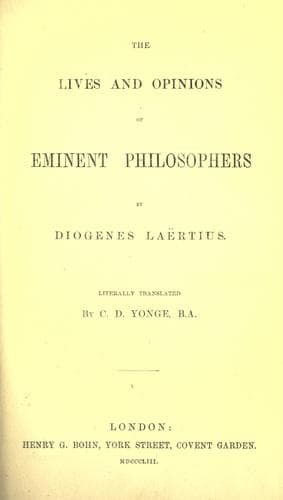
The Lives and Opinions of Eminent PhilosophersDiogenes Laertius
Philosophy
The Lives and Opinions of Eminent Philosophers
Diogenes Laertius
Philosophers, Ancient -- Biography; Philosophy, Ancient
XII. And he used to be very indignant with those who neglected proper
opportunities of applying themselves to learning; and he had a peculiar
habit, while conversing, of using the expression, “I think,” and “So and
so,” naming the person, “will not agree to this.” And this was imitated
by several of his pupils, who copied also his style of expression and
everything about him. He was a man very ready at inventing new words, and
very quick at meeting objections, and at bringing round the conversation
to the subject before him, and at adapting it to every occasion, and he
was the most convincing speaker that could be found, on which account
numbers of people flocked to his school, in spite of being somewhat
alarmed at his severity, which however they bore with complacency, for
he was a very kind man, and one who inspired his hearers with abundant
hope, and in his manner of life he was very affable and liberal, always
ready to do any one a service without any parade, and shrinking from
any expression of gratitude on the part of those whom he had obliged.
Accordingly once, when he had gone to visit Ctesibius who was ill, seeing
him in great distress from want, he secretly slipped his purse under his
pillow; and when Ctesibius found it, “This,” said he, “is the amusement
of Arcesilaus.” And at another time he sent him a thousand drachmas.
He it was also who introduced Archias the Arcadian to Eumenes, and who
procured him many favours from him.
XIII. And being a very liberal man and utterly regardless of money, he
made the most splendid display of silver plate, and in his exhibition
of gold plate he vied with that of Archecrates and Callicrates; and he
was constantly assisting and contributing to the wants of others with
money; and once, when some one had borrowed from him some articles of
silver plate to help him entertain his friends, and did not offer to
return them, he never asked for them back or reclaimed them; but some say
that he lent them with the purpose that they should be kept, and that
when the man returned them, he made him a present of them as he was a
poor man. He had also property in Pitana, the revenues from which were
transmitted to him by his brother Pylades.
Public-domain text, read in full here on John Shaqi.
Reviews
Reviews
No reviews yet
Be the first to share your thoughts on this work.
Elsewhere in the archive
Join the Discussion
Join the discussion
Sign in to leave a comment or review.
Sign InorCreate an account