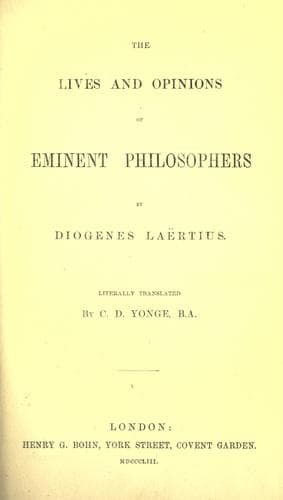
The Lives and Opinions of Eminent PhilosophersDiogenes Laertius
Philosophy
The Lives and Opinions of Eminent Philosophers
Diogenes Laertius
Philosophers, Ancient -- Biography; Philosophy, Ancient
We hear that Bion the Borysthenite,
Whom the ferocious Scythian land brought forth,
Used to deny that there were Gods at all.
Now, if he’d persevered in this opinion,
One would have said he speaks just as he thinks;
Though certainly his thoughts are quite mistaken.
But when a lengthened sickness overtook him,
And he began to fear lest he should die;
This man who heretofore denied the Gods,
And would not even look upon a temple,
And mocked all those who e’er approached the Gods
With prayer or sacrifice; who ne’er, not even
For his own hearth, and home, and household table,
Regaled the Gods with savoury fat and incense,
Who never once said, “I have sinned, but spare me.”
Then did this atheist shrink, and give his neck
To an old woman to hang charms upon,
And bound his arms with magic amulets,
With laurel branches blocked his doors and windows,
Ready to do and venture anything
Rather than die. Fool that he was, who thought
To win the Gods to come into existence,
Whenever he might think he wanted them.
So wise too late, when now mere dust and ashes,
He put his hand forth, Hail, great Pluto, Hail!
XI. There were ten people of the name of Bion. First of all, the one
who flourished at the same time with Pherecydes of Syros, and who has
left two books behind him, which are still extant; he was a native
of Proconnesus. The second was a Syracusan, the author of a system of
rhetoric. The third was the man of whom we have been speaking. The fourth
was a pupil of Democritus, and a mathematician, a native of Abdera,
who wrote in both the Attic and Ionic dialect. He was the person who
first asserted that there were countries where there was night for six
months, and day for six months. The fifth was a native of Soli; who
wrote a history of Æthiopia. The sixth was a rhetorician, who has left
behind him nine books, inscribed with the names of the Muses, which are
still extant. The eighth was a Milesian statuary, who is mentioned by
Polemo. The ninth was a tragic poet of the number of those who are called
Tarsicans. The tenth was a statuary, a native of Clazomenæ or Chios, who
is mentioned by Hipponax.
LIFE OF LACYDES.
I. Lacydes, the son of Alexander, was a native of Cyrene. He it is who
was the founder of the New Academy, having succeeded Arcesilaus; and he
was a man of great gravity of character and demeanour, and one who had
many imitators.
II. He was industrious from his very childhood, and poor, but very
pleasing and sociable in his manners.
Public-domain text, read in full here on John Shaqi.
Reviews
Reviews
No reviews yet
Be the first to share your thoughts on this work.
Elsewhere in the archive
Join the Discussion
Join the discussion
Sign in to leave a comment or review.
Sign InorCreate an account