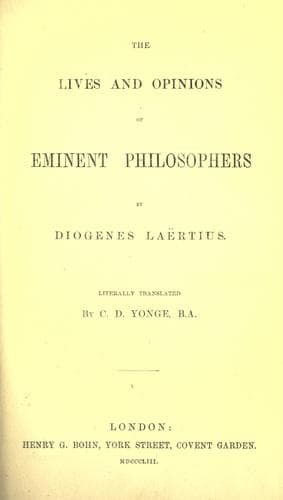
The Lives and Opinions of Eminent PhilosophersDiogenes Laertius
Philosophy
The Lives and Opinions of Eminent Philosophers
Diogenes Laertius
Philosophers, Ancient -- Biography; Philosophy, Ancient
IV. He was also the first person who ever gave a definition of discourse,
saying, “Discourse is that which shows what anything is or was.” And
he used continually to say, “I would rather go mad than feel pleasure.”
And, “One ought to attach one’s self to such women as will thank one for
it.” He said once to a youth from Pontus, who was on the point of coming
to him to be his pupil, and was asking him what things he wanted, “You
want a new book, and a new pen, and a new tablet;”—meaning a new mind.
And to a person who asked him from what country he had better marry a
wife, he said, “If you marry a handsome woman, she will be common;[54]
if an ugly woman, she will be a punishment to you.” He was told once
that Plato spoke ill of him, and he replied, “It is a royal privilege
to do well, and to be evil spoken of.” When he was being initiated
into the mysteries of Orpheus, and the priest said that those who were
initiated enjoyed many good things in the shades below, “Why, then,” said
he “do not you die?” Being once reproached as not being the son of two
free citizens, he said, “And I am not the son of two people skilled in
wrestling; nevertheless, I am a skilful wrestler.” On one occasion he was
asked why he had but few disciples, and said, “Because I drove them away
with a silver rod.” When he was asked why he reproved his pupils with
bitter language, he said, “Physicians too use severe remedies for their
patients.” Once he saw an adulterer running away, and said, “O unhappy
man! how much danger could you have avoided for one obol!” He used to
say, as Hecaton tells us in his Apophthegms, “That it was better to fall
among crows,[55] than among flatterers; for that they only devour the
dead, but the others devour the living.” When he was asked what was the
most happy event that could take place in human life, he said, “To die
while prosperous.”
On one occasion one of his friends was lamenting to him that he had
lost his memoranda, and he said to him, “You ought to have written them
on your mind, and not on paper.” A favourite saying of his was, “That
envious people were devoured by their own disposition, just as iron is
by rust.” Another was, “That those who wish to be immortal ought to live
piously and justly.” He used to say too, “That cities were ruined when
they were unable to distinguish worthless citizens from virtuous ones.”
Public-domain text, read in full here on John Shaqi.
Reviews
Reviews
No reviews yet
Be the first to share your thoughts on this work.
Elsewhere in the archive
Join the Discussion
Join the discussion
Sign in to leave a comment or review.
Sign InorCreate an account