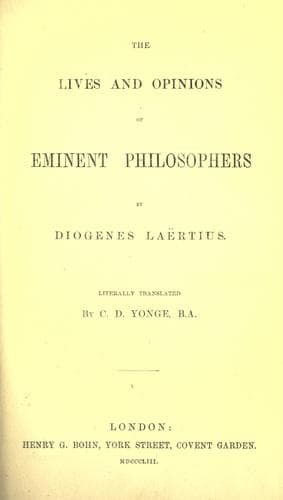
The Lives and Opinions of Eminent PhilosophersDiogenes Laertius
Philosophy
The Lives and Opinions of Eminent Philosophers
Diogenes Laertius
Philosophers, Ancient -- Biography; Philosophy, Ancient
IV. Antisthenes, in his Successions, says that he, having once, in a
certain tragedy, seen Telephus holding a date basket, and in a miserable
plight in other respects, betook himself to the Cynic philosophy; and
having turned his patrimony into money (for he was of illustrious
extraction), he collected three hundred talents by that means, and
divided them among the citizens. And after that he devoted himself
to philosophy with such eagerness, that even Philemon the comic poet
mentions him. Accordingly he says:—
And in the summer he’d a shaggy gown,
To inure himself to hardship: in the winter
He wore mere rags.
But Diocles says that it was Diogenes who persuaded him to discard all
his estate and his flocks, and to throw his money into the sea; and he
says further, that the house of Crates was destroyed by Alexander, and
that of Hipparchia under Philip. And he would very frequently drive away
with his staff those of his relations who came after him, and endeavoured
to dissuade him from his design; and he remained immoveable.
V. Demetrius, the Magnesian, relates that he deposited his money with
a banker, making an agreement with him, that if his sons turned out
ordinary ignorant people, he was then to restore it to them; but if they
became philosophers, then he was to divide it among the people, for that
they, if they were philosophers, would have no need of anything. And
Eratosthenes tells us that he had by Hipparchia, whom we shall mention
hereafter, a son whose name was Pasicles, and that when he grew up, he
took him to a brothel kept by a female slave, and told him that that was
all the marriage that his father designed for him; but that marriages
which resulted in adultery were themes for tragedians, and had exile and
bloodshed for their prizes; and the marriages of those who lived with
courtesans were subjects for the comic poets, and often produced madness
as the result of debauchery and drunkenness.
VI. He had also a brother named Pasicles, a pupil of Euclides.
VII. Phavorinus, in the second book of his Commentaries, relates a witty
saying of his; for he says, that once, when he was begging a favour of
the master of a gymnasium, on the behalf of some acquaintance, he touched
his thighs; and as he expressed his indignation at this, he said, “Why,
do they not belong to you as well as your knees?” He used to say that it
was impossible to find a man who had never done wrong, in the same way as
there was always some worthless seed in a pomegranate. On one occasion
he provoked Nicodromus, the harp-player, and received a black eye from
him; so he put a plaster on his forehead and wrote upon it, “Nicodromus
did this.” He used to abuse prostitutes designedly, for the purpose of
practising himself in enduring reproaches. When Demetrius Phalereus sent
him some loaves and wine, he attacked him for his present, saying, “I
wish that the fountains bore loaves;” and it is notorious that he was a
water drinker.
Public-domain text, read in full here on John Shaqi.
Reviews
Reviews
No reviews yet
Be the first to share your thoughts on this work.
Elsewhere in the archive
Join the Discussion
Join the discussion
Sign in to leave a comment or review.
Sign InorCreate an account