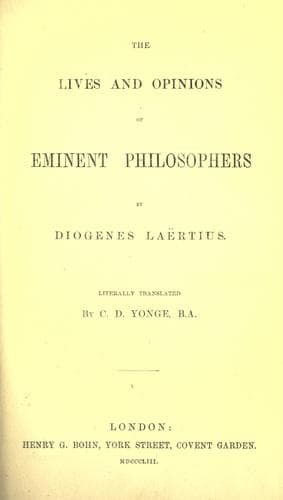
The Lives and Opinions of Eminent PhilosophersDiogenes Laertius
Philosophy
The Lives and Opinions of Eminent Philosophers
Diogenes Laertius
Philosophers, Ancient -- Biography; Philosophy, Ancient
II. Both she and Metrocles were natives of Maronea. She fell in love with
both the doctrines and manners of Crates, and could not be diverted from
her regard for him, by either the wealth, or high birth, or personal
beauty, of any of her suitors, but Crates was everything to her; and she
threatened her parents to make away with herself, if she were not given
in marriage to him. Crates accordingly, being entreated by her parents to
dissuade her from this resolution, did all he could; and at last, as he
could not persuade her, he rose up, and placing all his furniture before
her, he said, “This is the bridegroom whom you are choosing, and this
is the whole of his property; consider these facts, for it will not be
possible for you to become his partner, if you do not also apply yourself
to the same studies, and conform to the same habits that he does.” But
the girl chose him; and assuming the same dress that he wore, went about
with him as her husband, and appeared with him in public everywhere, and
went to all entertainments in his company.
III. And once when she went to sup with Lysimachus, she attacked
Theodorus, who was surnamed the Atheist; proposing to him the following
sophism; “What Theodorus could not be called wrong for doing, that same
thing Hipparchia ought not to be called wrong for doing. But Theodorus
does no wrong when he beats himself; therefore Hipparchia does no wrong
when she beats Theodorus.” He made no reply to what she said, but only
pulled her clothes about; but Hipparchia was neither offended nor
ashamed, as many a woman would have been; but when he said to her:—
“Who is the woman who has left the shuttle
So near the warp?”[78]
“I, Theodorus, am that person,” she replied; “but do I appear to you to
have come to a wrong decision, if I devote that time to philosophy, which
I otherwise should have spent at the loom?” And these and many other
sayings are reported of this female philosopher.
IV. There is also a volume of letters of Crates[79] extant, in which he
philosophizes most excellently; and in style is very little inferior to
Plato. He also wrote some tragedies, which are imbued with a very sublime
spirit of philosophy, of which the following lines are a specimen:—
’Tis not one town, nor one poor single house,
That is my country; but in every land
Each city and each dwelling seems to me,
A place for my reception ready made.
And he died at a great age, and was buried in Bœotia.
LIFE OF MENIPPUS.
I. Menippus was also a Cynic, and a Phœnician by descent, a slave by
birth, as Achaicus tells us in his Ethics; and Diocles informs us that
his master was a native of Pontus, of the name of Baton; but that
subsequently, in consequence of his importunities and miserly habits, he
became rich, and obtained the rights of citizenship at Corinth.
Public-domain text, read in full here on John Shaqi.
Reviews
Reviews
No reviews yet
Be the first to share your thoughts on this work.
Elsewhere in the archive
Join the Discussion
Join the discussion
Sign in to leave a comment or review.
Sign InorCreate an account