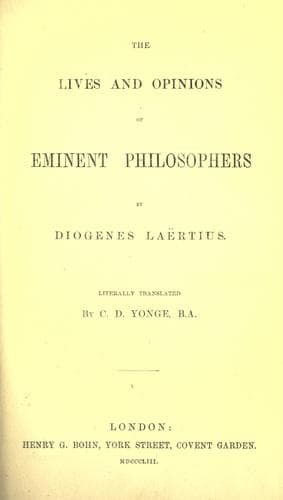
The Lives and Opinions of Eminent PhilosophersDiogenes Laertius
Philosophy
The Lives and Opinions of Eminent Philosophers
Diogenes Laertius
Philosophers, Ancient -- Biography; Philosophy, Ancient
For he said that that man who had the capacity to give a proper hearing
to what was said, and to avail himself of it, was superior to him who
comprehended everything by his own intellect; for that the one had only
comprehension, but the one who took good advice had action also.
XXII. When he was asked why he, who was generally austere, relaxed at a
dinner party, he said, “Lupins too are bitter, but when they are soaked
they become sweet.” And Hecaton, in the second book of his Apophthegms,
says, that in entertainments of that kind, he used to indulge himself
freely. And he used to say that it was better to trip with the feet, than
with the tongue. And that goodness was attained by little and little,
but was not itself a small thing. Some authors, however, attribute this
saying to Socrates.
XXIII. He was a person of great powers of abstinence and endurance; and
of very simple habits, living on food which required no fire to dress it,
and wearing a thin cloak, so that it was said of him:—
The cold of winter, and the ceaseless rain,
Come powerless against him; weak is the dart
Of the fierce summer sun, or fell disease,
To bend that iron frame. He stands apart,
In nought resembling the vast common crowd;
But, patient and unwearied, night and day,
Clings to his studies and philosophy.
XXIV. And the comic poets, without intending it, praise him in their very
attempts to turn him into ridicule. Philemon speaks thus of him in his
play entitled the Philosophers:—
This man adopts a new philosophy,
He teaches to be hungry; nevertheless,
He gets disciples. Bread his only food,
His best desert dried figs; water his drink.
But some attribute these lines to Posidippus. And they have become
almost a proverb. Accordingly it used to be said of him, “More temperate
than Zeno the philosopher.” Posidippus also writes thus in his Men
Transported:—
So that for ten whole days he did appear
More temperate than Zeno’s self.
XXV. For in reality he did surpass all men in this description of virtue,
and in dignity of demeanour, and, by Jove, in happiness. For he lived
ninety-eight years, and then died, without any disease, and continuing in
good health to the last. But Persæus, in his Ethical School, states that
he died at the age of seventy-two, and that he came to Athens when he
was twenty-two years old. But Apollonius says that he presided over his
school for forty-eight years.
XXVI. And he died in the following manner. When he was going out of his
school, he tripped, and broke one of his toes; and striking the ground
with his hand, he repeated the line out of the Niobe:—
I come: why call me so?
And immediately he strangled himself, and so he died. But the Athenians
buried him in the Ceramicus, and honoured him with the decrees which I
have mentioned before, bearing witness to his virtue. And Antipater, the
Sidonian, wrote an inscription for him, which runs thus:—
Public-domain text, read in full here on John Shaqi.
Reviews
Reviews
No reviews yet
Be the first to share your thoughts on this work.
Elsewhere in the archive
Join the Discussion
Join the discussion
Sign in to leave a comment or review.
Sign InorCreate an account