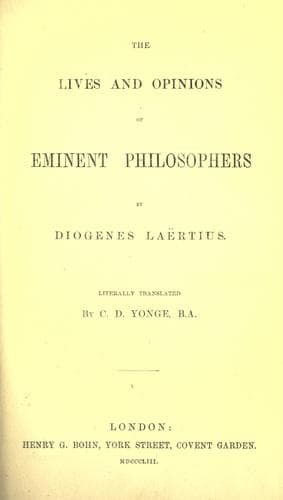
The Lives and Opinions of Eminent PhilosophersDiogenes Laertius
Philosophy
The Lives and Opinions of Eminent Philosophers
Diogenes Laertius
Philosophers, Ancient -- Biography; Philosophy, Ancient
XXXI. The disciples of Zeno were very numerous. The most eminent were,
first of all, Persæus, of Cittium, the son of Demetrius, whom some call
a friend of his, but others describe him as a servant and one of the
amanuenses who were sent to him by Antigonus, to whose son, Halcyoneus,
he also acted as tutor. And Antigonus once, wishing to make trial of him,
caused some false news to be brought to him that his estate had been
ravaged by the enemy; and as he began to look gloomy at this news, he
said to him, “You see that wealth is not a matter of indifference.”
The following works are attributed to him. One on Kingly Power; one
entitled the Constitution of the Lacedæmonians; one on Marriage; one
on Impiety; the Thyestes; an Essay on Love; a volume of Exhortations;
one of Conversations; four of Apophthegms; one of Reminiscences; seven
treatises, the Laws of Plato.
The next was Ariston, of Chios, the son of Miltiades, who was the
first author of the doctrine of indifference; then Herillus, who
called knowledge the chief good; then Dionysius, who transferred this
description to pleasure; as, on account of the violent disease which he
had in his eyes, he could not yet bring himself to call pain a thing
indifferent. He was a native of Heraclea; there was also Sphærus, of the
Bosphorus; and Cleanthes, of Assos, the son of Phanias, who succeeded him
in his school, and whom he used to liken to tablets of hard wax, which
are written upon with difficulty, but which retain what is written upon
them. And after Zeno’s death, Sphærus became a pupil of Cleanthes. And we
shall speak of him in our account of Cleanthes.
These also were all disciples of Zeno, as we are told by Hippobotus,
namely:—Philonides, of Thebes; Callippus, of Corinth; Posidonius, of
Alexandria; Athenodorus, of Soli; and Zeno, a Sidonian.
XXXII. And I have thought it best to give a general account of all the
Stoic doctrines in the life of Zeno, because he it was who was the
founder of the sect.
He has written a great many books, of which I have already given a list,
in which he has spoken as no other of the Stoics has. And his doctrines
in general are these. But we will enumerate them briefly, as we have been
in the habit of doing in the case of the other philosophers.
Public-domain text, read in full here on John Shaqi.
Reviews
Reviews
No reviews yet
Be the first to share your thoughts on this work.
Elsewhere in the archive
Join the Discussion
Join the discussion
Sign in to leave a comment or review.
Sign InorCreate an account