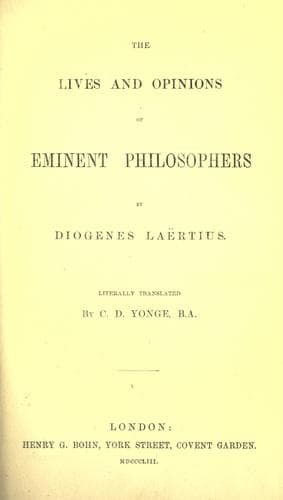
The Lives and Opinions of Eminent PhilosophersDiogenes Laertius
Philosophy
The Lives and Opinions of Eminent Philosophers
Diogenes Laertius
Philosophers, Ancient -- Biography; Philosophy, Ancient
Again, the world is inhabited and regulated according to intellect
and providence, as Chrysippus says, in his works on Providence, and
Posidonius in the thirteenth book of his treatise on Gods, since mind
penetrates into every part of the world, just as the soul pervades us;
but it is in a greater degree in some parts, and in a less degree in
others. For instance, it penetrates as a habit, as, for instance, into
the bones and sinews; and into some it penetrates as the mind does, for
instance, into the dominant principle. And thus the whole world, being
a living thing, endowed with a soul and with reason, has the æther as
its dominant principle, as Antipater, of Tyre, says in the eighth book
of his treatise on the World. But Chrysippus, in the first book of his
essay on Providence, and Posidonius in his treatise on Gods, say that the
heaven is the dominant principle of the world; and Cleanthes attributes
this to the sun. Chrysippus, however, on this point contradicts himself;
for he says in another place, that the most subtle portion of the æther,
which is also called by the Stoics the first God, is what is infused in
a sensible manner into all the beings which are in the air, and through
every animal and every plant, and through the earth itself according to a
certain habit; and that it is this which communicates to them the faculty
of feeling.
They say too, that the world is one and also finite, having a spherical
form. For that such a shape is the most convenient for motion, as
Posidonius says, in the fifteenth book of his Discussions on Natural
Philosophy, and so says Antipater also in his essay on the World. And
on the outside there is diffused around it a boundless vacuum, which is
incorporeal. And it is incorporeal inasmuch, as it is capable of being
contained by bodies, but is not so. And that there is no such thing as
a vacuum in the world, but that it is all closely united and compact;
for that this condition is necessarily brought about by the concord
and harmony which exist between the heavenly bodies and those of the
earth. And Chrysippus mentions a vacuum in his essay on a Vacuum, and
also in the first book of his treatise on the Physical Arts, and so
does Apollophanes in his Natural Philosophy, and so does Apollodorus,
and so does Posidonius in the second book of his discourses on Natural
Philosophy. And they say that these things are all incorporeal, and all
alike. Moreover, that time is incorporeal, since it is an interval of the
motion of the world. And that of time, the past and the future are both
illimitable, but the present is limited. And they assert that the world
is perishable, inasmuch as it was produced by reason, and is one of the
things which are perceptible by the senses; and whatever has its parts
perishable, must also be perishable in the whole. And the parts of the
world are perishable, for they change into one another. Therefore, the
whole world is perishable. And again, if anything admits of a change for
Public-domain text, read in full here on John Shaqi.
Reviews
Reviews
No reviews yet
Be the first to share your thoughts on this work.
Elsewhere in the archive
Join the Discussion
Join the discussion
Sign in to leave a comment or review.
Sign InorCreate an account