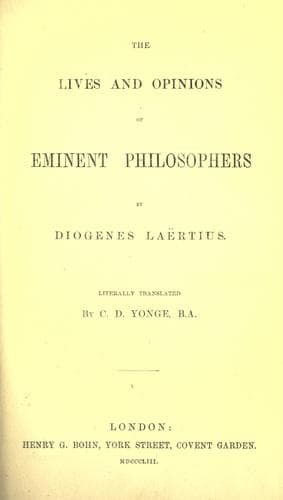
The Lives and Opinions of Eminent PhilosophersDiogenes Laertius
Philosophy
The Lives and Opinions of Eminent Philosophers
Diogenes Laertius
Philosophers, Ancient -- Biography; Philosophy, Ancient
The substance of God is asserted by Zeno to be the universal world, and
the heaven; and Chrysippus agrees with this doctrine, in his eleventh
book on the Gods, and so also does Posidonius, in the first book of his
treatise on the same subject. Antipater, in the seventh book of his
treatise on the World, says that his substance is aërial. And Boethus,
in his treatise on Nature, calls the substance of God the sphere of the
fixed stars.
LXXIII. And his nature they define to be, that which keeps the world
together, and sometimes that which produces the things upon the earth.
And nature is a habit which derives its movements from itself, perfecting
and holding together all that arises out of it, according to the
principles of production, in certain definite periods, and doing the same
as the things from which it is separated. And it has for its object,
suitableness and pleasure, as is plain from its having created man.
LXXIV. But Chrysippus, in his treatise on Fate, and Posidonius, in the
second book of his work on Fate, and Zeno, and Boethus, in the eleventh
book of his treatise on Fate, say, that all things are produced by fate.
And fate, (εἱμαρμένη), is a connected (εἰρομένη) cause of existing
things, or the reason according to which the world is regulated.
LXXV. They also say that divination has a universal existence, since
Providence has; and they define it as an act on account of certain
results, as Zeno and Chrysippus, in the second book of his treatise on
Divination, and Athenodorus and Posidonius, in the twelfth book of his
discourses on Natural Philosophy, and in the fifth book of his treatise
on Divination, all agree in saying; for Panætius denies that it has any
certain foundation.
LXXVI. And they say that the substance of all existing things is Primary
Matter, as Chrysippus asserts in the first book of his Physics; and
Zeno says the same. Now matter is that from which anything whatever is
produced. And it is called by a twofold appellation, essence and matter;
the one as relating to all things taken together, and the other to things
in particular and separate. The one which relates to all things taken
together, never becomes either greater or less; but the one relating to
things in particular, does become greater or less, as the case may be.
LXXVII. Body is, according to them, a substance and finite; as Antipater
says, in the second book of his treatise on Substance; and Apollodorus,
in his Natural Philosophy, agrees with him. It is also subject to change,
as we learn from the same author; for if it were immutable, then the
things which have been produced out of it would not have been produced;
on which account he also says that it is infinitely divisible: but
Chrysippus denies that it is infinite; for that nothing is infinite,
which is divisible at all.
Public-domain text, read in full here on John Shaqi.
Reviews
Reviews
No reviews yet
Be the first to share your thoughts on this work.
Elsewhere in the archive
Join the Discussion
Join the discussion
Sign in to leave a comment or review.
Sign InorCreate an account