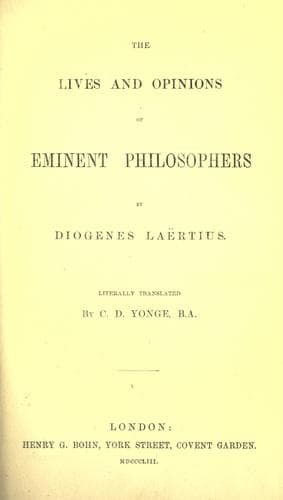
The Lives and Opinions of Eminent PhilosophersDiogenes Laertius
Philosophy
The Lives and Opinions of Eminent Philosophers
Diogenes Laertius
Philosophers, Ancient -- Biography; Philosophy, Ancient
The sixth set contains, a treatise against those who believe Truth and
Falsehood to be the same thing. One, in two books, against those who have
recourse to division to resolve the Fallacy, addressed to Aristocreon; a
demonstrative essay, to prove that it is not proper to divide indefinite
terms; an essay, in three books, in answer to the objections against
the non-division of Indefinite Terms, addressed to Pasylus; a solution,
according to the principles of the ancients, addressed to Dioscorides; an
essay on the Resolution of the Fallacy, addressed to Aristocreon, this is
in three books; a resolution of the Hypothetical Arguments of Hedylus,
in one book, addressed to Aristocreon and Apollos.
The seventh set contains, a treatise against those who contend that
the premisses on the Fallacy, are false; a treatise on Negative
Reasoning, addressed to Aristocreon, in two books; one book of Negative
Reasonings, addressed to Gymnasias; two books of a treatise on Reasoning
by Progression, addressed to Stesagoras; two books of Reasonings by
Interrogation, and on the Arrest,[105] addressed to Onetor; an essay, in
two books, on the Corrected Argument, addressed to Aristobulus; another
on the Non-apparent Argument, addressed to Athenades.
The eighth set contains, an essay on the Argument Outis, in eight books,
addressed to Menecrates; a treatise, in two books, on Arguments composed
of a finite term, and an indefinite term, addressed to Pasylus; another
essay on the Argument Outis, addressed to Epicrates.
The ninth set contains, two volumes of Sophisms, addressed to Heraclides,
and Pollis; five volumes of Dialectic Arguments, which admit of no
solution, addressed to Dioscorides; an essay, in one book, against the
Method of Arcesilaus, addressed to Sphærus.
The tenth set contains, a treatise in six books, against Custom,
addressed to Metrodorus; and another, in seven books, on Custom,
addressed to Gorgippides.
There are, therefore, works on Logic, in the four grand classes which we
have here enumerated, embracing various questions, without any connection
with one another, to the number of thirty nine sets, amounting in the
whole to three hundred and eleven treatises on Logic.
The next division comprises those works which have for their object, the
explanation of Moral Ideas.
The first class of this division, contains an essay, giving a description
of Reason, addressed to Theosphorus; a book of Ethical questions; three
books of Principles, to serve as the foundation of Dogmas, addressed
to Philomathes; two books of definitions of Good-breeding, addressed
to Metrodorus; two books of definitions of the Bad, addressed to
Metrodorus; two books of definitions of Neutral Things, addressed also
to Metrodorus; seven books of definitions of Things, according to their
genera, addressed to Metrodorus; and two books of Definitions, according
to other systems, addressed to Metrodorus.
Public-domain text, read in full here on John Shaqi.
Reviews
Reviews
No reviews yet
Be the first to share your thoughts on this work.
Elsewhere in the archive
Join the Discussion
Join the discussion
Sign in to leave a comment or review.
Sign InorCreate an account