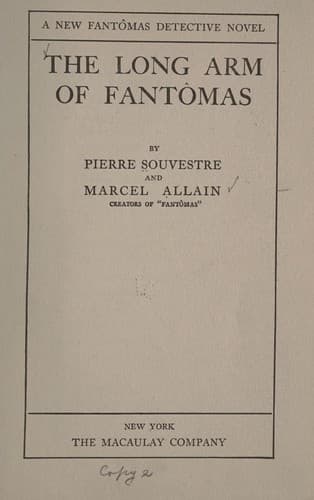
Detective and mystery stories; Fantômas (Fictitious character) -- Fiction
Such were the young man’s thoughts when the landlord of _The Orange
Blossom_ suddenly burst into the eating room.
“Daniel,” he cried, “you must make haste, my lad! here’s the wedding
party coming, they’re not late after all; quick, put on your apron and
jacket, breakfast will be served instanter!”
Two landaus had just drawn up at the entrance to the gardens, two
simple, unpretending vehicles, with none of your wide plate-glass
windows, none of your big carriage lamps at the four corners of the
coach.
CHAPTER XXIII
THE WEDDING BREAKFAST
As Ascott desired the wedding was carried out in the strictest
privacy. The party reached the _Mairie_ at an early hour. Ascott had
for witnesses his man servant John, and a casual secretary from the
Consulate, bound over to the closest secrecy. Moreover, the young man
in question, a person of much discretion who saw how things were with
half an eye, had vanished immediately after the ceremony, saying he
did not care to attend the breakfast, understanding in fact that his
absence would not be taken in ill part, but very much the reverse.
Nini Guinon’s witnesses were her uncle, Père Moche, recruited again
for the purpose, and the vagabond Bouzille, who had been fetched from
a drinking shop at Ménilmontant, and dressed up for the occasion in a
second-hand frock coat. The formalities at the _Mairie_ were quickly
completed, the party adjourned to hear a mass at the nearest church,
and then set off for the Bois de Vincennes.
The last act of the grotesque adventure, the wedding breakfast,
remained to be staged. Ascott, to Mme. Guinon’s bitter chagrin, had
emphatically refused to make her acquaintance, thereby making the good
woman desperately unhappy. Thus she had barely caught a glimpse of her
son-in-law, when at the _Mairie_ she authorized her daughter as a minor
to pronounce a definitive and binding “Yes.” Ascott, in fact, had shown
himself quite uncompromising all the morning. For this marriage, this
hole and corner marriage, so to speak, in which he had systematically
avoided all publicity, he had not chosen that his bride should wear the
orthodox white gown sacred to such occasions. In a word, the ceremony
was a gloomy, funereal function, depressing to the last degree.
It was abundantly clear the bridegroom was fulfilling a duty, carrying
out an irksome obligation; indeed, the whole thing wore so lugubrious
an aspect that Nini Guinon began to feel anxious, asking herself if
really and truly she had acted wisely in following old Moche’s advice,
for at the bottom of her heart she was far from convinced of the
advantages to accrue for her from her union with the rich Englishman.
On the drive to the restaurant, sitting silent in her corner of the
carriage, Nini was thinking all the while:
“If I’m in for a bad time, if old Moche has got me in a hole, I’ll make
him pay for it.”
Public-domain text, read in full here on John Shaqi.
Reviews
Reviews
No reviews yet
Be the first to share your thoughts on this work.
Elsewhere in the archive
Join the Discussion
Join the discussion
Sign in to leave a comment or review.
Sign InorCreate an account