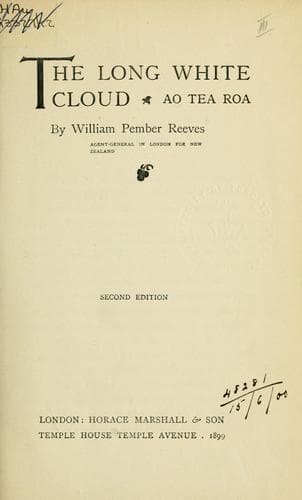
The Long White Cloud: "Ao Tea Roa"Reeves, William Pember
History
The Long White Cloud: "Ao Tea Roa"
Reeves, William Pember
Ethnology -- New Zealand; New Zealand
The next little colony founded in New Zealand dates its birth from
1850. Though it was to be Otago's next-door neighbour, it was neither
Presbyterian nor Scottish, but English and Episcopalian. This was the
Canterbury settlement. It owed its existence to an association in
which the late Lord Lyttelton was prominent. As in the case of Otago,
this association worked in conjunction with the New Zealand Company,
and proposed to administer its lands on the Wakefield system. Gibbon
Wakefield himself (his brother, the Colonel, had died in 1847)
laboured untiringly at its foundation, amid troubles which were
all the more annoying in that the association was in financial
difficulties from its birth.[1] Three pounds an acre was to be the
price of land in the Canterbury Block, of which one pound was to go
to the church and education, two pounds to be spent on the work of
development. The settlers landed in December, 1850, from four vessels,
the immigrants in which have ever since had in their new home the
exclusive right to the name of Pilgrims. The dream of the founders of
Canterbury was to transport to the Antipodes a complete section of
English society, or, more exactly, of the English Church. It was to be
a slice of England from top to bottom. At the top were to be an Earl
and a Bishop; at the bottom the English labourer, better clothed,
better fed, and contented. Their square, flat city they called
Christchurch, and its rectangular streets by the names of the Anglican
Bishoprics. One schismatic of a street called High was alone allowed
to cut diagonally across the lines of its clerical neighbours. But the
clear stream of the place, which then ran past flax, koromiko, and
glittering toé-toé, and now winds under weeping-willows, the founders
spared from any sacerdotal name; it is called Avon. When wooden
cottages and "shedifices" began to dot the bare urban sections
far apart, the Pilgrims called their town the City of Magnificent
Distances, and cheerfully told you how new-comers from London rode
through and out of Christchurch and thereafter innocently inquired
whether the town still lay much ahead. The Canterbury dream seems a
little pathetic as well as amusing now, but those who dreamed it were
very much in earnest in 1850, and they laid the foundation stones of a
fine settlement, though not precisely of the kind they contemplated.
Their affairs for some years were managed by John Robert Godley, a
name still well remembered at the War Office, where he afterwards
became Under-Secretary. He had been the life and soul of the
Canterbury Association, and as its agent went out to New Zealand,
partly in search of health and partly with the honourable ambition
to found a colony worthy of England. He made a strong administrator.
Their Earl and their Bishop soon fled from the hard facts of pioneer
life, but the Pilgrims as a rule were made of sterner stuff, and
sticking to their task, they soon spread over the yellow, sunny
Public-domain text, read in full here on John Shaqi.
Reviews
Reviews
No reviews yet
Be the first to share your thoughts on this work.
Elsewhere in the archive
Join the Discussion
Join the discussion
Sign in to leave a comment or review.
Sign InorCreate an account