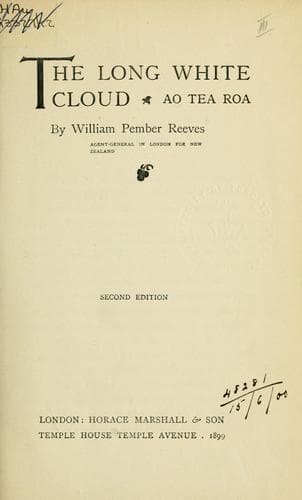
The Long White Cloud: "Ao Tea Roa"Reeves, William Pember
History
The Long White Cloud: "Ao Tea Roa"
Reeves, William Pember
Ethnology -- New Zealand; New Zealand
where he is about to begin that work of reclaiming the desert which
has been going on in Europe for thousands of years, and of which
the average civilized man is the calm, self-satisfied, unconscious
inheritor, finds that he must shift his point of view! The
nineteenth-century Briton face to face with the conditions of
primitive man is a spectacle fine in the general, but often ludicrous
or piteous in the particular. The loneliness, the coarseness, the
everlasting insistence of the pettiest and most troublesome wants and
difficulties, harden and brace many minds, but narrow most and torment
some. Wild game, song-birds, fish, forest trees, were but some of the
things of which there were few or none round nearly all the young
pastoral settlements. Everything was to make. The climate might be
healthy and the mountain outlines noble. But nothing but work, and
successful work, could reconcile an educated and imaginative man to
the monotony of a daily outlook over league after league of stony
soil, thinly clothed by pallid, wiry tussocks bending under an
eternal, uncompromising wind; where the only living creatures in sight
might often be small lizards or a twittering grey bird miscalled a
lark; or where the only sound, save the wind aforesaid, might be
the ring of his horse's shoe against a stone, or the bleat of a
dull-coated merino, scarcely distinguishable from the dull plain round
it. To cure an unfit new-comer, dangerously enamoured of the
romance of colonization, few experiences could surpass a week of
sheep-driving, where life became a prolonged crawl at the heels of a
slow, dusty, greasy-smelling "mob" straggling along at a maximum pace
of two miles an hour. If patience and a good collie helped the tyro
through that ordeal, such allies were quite too feeble to be of
service in the supreme trial of bullock-driving, where a long whip and
a vocabulary copious beyond the dreams of Englishmen were the only
effective helpers known to man in the management of the clumsy dray
and the eight heavy-yoked, lumbering beasts dragging it. Wonderful
tales are told of cultivated men in the wilderness, Oxonians disguised
as station-cooks, who quoted Virgil over their dish-washing or asked
your opinion on a tough passage of Thucydides whilst baking a batch of
bread. Most working settlers, as a matter of fact, did well enough
if they kept up a running acquaintance with English literature; and
station-cooks, as a race, were ever greater at grog than at Greek.
Public-domain text, read in full here on John Shaqi.
Reviews
Reviews
No reviews yet
Be the first to share your thoughts on this work.
Elsewhere in the archive
Join the Discussion
Join the discussion
Sign in to leave a comment or review.
Sign InorCreate an account