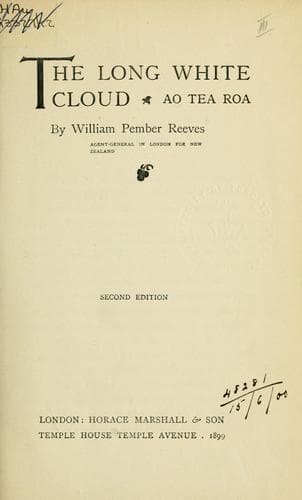
The Long White Cloud: "Ao Tea Roa"Reeves, William Pember
History
The Long White Cloud: "Ao Tea Roa"
Reeves, William Pember
Ethnology -- New Zealand; New Zealand
Neither in Canterbury nor Otago were the plough and the spade found to
be the instruments of speediest advance. They were soon eclipsed by
the stockwhip, the shears, the sheep-dog, and the wire-fence. Long
before the foundation of New Zealand, Macarthur had taught the
Australians to acclimatize the merino sheep. Squatters and shepherds
from New South Wales and Tasmania were quick to discover that the
South Island of New Zealand was a well-nigh ideal land for pastoral
enterprise, with a climate where the fleece of a well-bred merino
sheep would yield 4 lbs. of wool as against 21/2 lbs. in New South
Wales. Coming to Canterbury, Otago, and Nelson, they taught the new
settlers to look to wool and meat, rather than to oats and wheat,
for profit and progress. The Australian _coo-ee_, the Australian
buck-jumping horse, the Australian stockwhip and wide-awake hat came
into New Zealand pastoral life, together with much cunning in dodging
land-laws, and a sovereign contempt for small areas. In a few
years the whole of the east and centre of the island, except a few
insignificant cultivated patches, was leased in great "runs" of from
10,000 to 100,000 acres to grazing tenants. The Australian term
"squatter" was applied to and accepted good-humouredly by these.
Socially and politically, however, they were the magnates of the
colony; sometimes financially also, but not always. For the price of
sheep and wool could go down by leaps and bounds, as well as up; the
progeny of the ewes bought for 30s. each in 1862 might have to go at
5s. each in 1868, and greasy wool might fluctuate in value as much as
6d. a lb. Two or three bad years would deliver over the poor squatter
as bond-slave to some bank, mortgage company or merchant, to whom he
had been paying at least 10 per cent. interest, _plus_ 21/2 per cent.
commission exacted twice a year, on advances. In the end, maybe, his
mortgagee stepped in; he and his children saw their homestead, with
its garden and clumps of planted eucalypts, willows, and poplars--an
oasis in the grassy wilderness--no more. Sometimes a new squatter
reigned in his stead, sometimes for years the mortgagee left the place
in charge of a shepherd--a new and dreary form of absentee ownership.
Meanwhile, in the earlier years the squatters were merry monarchs,
reigning as supreme in the Provincial Councils as in the jockey clubs.
They made very wise and excessively severe laws to safeguard their
stock from infection, and other laws, by no means so wise, to
safeguard their runs from selection, laws which undoubtedly hampered
agricultural progress. The peasant cultivator, or "cockatoo" (another
Australian word), followed slowly in the sheep farmer's wake. As late
as 1857 there were not fifty thousand acres of land under tillage
in the South Island. Even wheat at 10s. a bushel did not tempt much
capital into agriculture, though such were the prices of cereals that
in 1855 growers talked dismally of the low price of oats--4s. 6d. a
bushel.
Public-domain text, read in full here on John Shaqi.
Reviews
Reviews
No reviews yet
Be the first to share your thoughts on this work.
Elsewhere in the archive
Join the Discussion
Join the discussion
Sign in to leave a comment or review.
Sign InorCreate an account