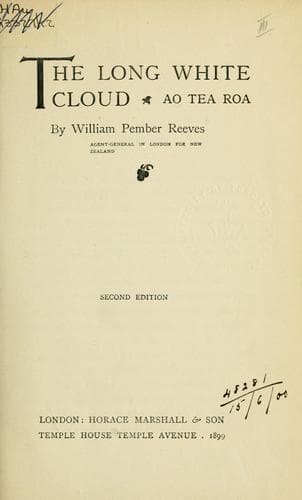
The Long White Cloud: "Ao Tea Roa"Reeves, William Pember
History
The Long White Cloud: "Ao Tea Roa"
Reeves, William Pember
Ethnology -- New Zealand; New Zealand
Grey was successful in inducing the Maoris to sell a fair amount of
their surplus land. During the last years of his rule and the four or
five years after he went, some millions of acres were bought in the
North Island. This, following on the purchase of the whole of the
South Island, had opened the way for real progress. The huge estate
thus gained by the Crown brought to the front new phases of the
eternal land problem. The question had to be faced as to what were to
be the terms under which this land was to be sold and leased to the
settlers. Up to 1852 the settlers everywhere, except in Auckland, had
to deal, not with the Crown, but with the New Zealand Company. But in
1852 the Company was wound up, and its species of overlordship finally
extinguished. By an English Act of Parliament its debt to the Imperial
Government was forgiven. The Colony was ordered to pay it £263,000
in satisfaction of its land lien. This was commuted in the end for
£200,000 cash, very grudgingly paid out of the first loan raised by a
New Zealand parliament. Thereafter, the Company, with its high aims,
its blunders, its grievances, and its achievements, vanishes from the
story of New Zealand.
In the Church settlements of the South the Wakefield system came into
full operation under favourable conditions. Three pounds an acre were
at the outset charged for land. One pound went to the churches and
their schools. This system of endowment Grey set himself to stop, when
the Company's fall gave him the opportunity, and he did so at the cost
of embittering his relations with the Southerners, which already were
none too pleasant. For the rest, Canterbury continued within its
original special area to sell land at £2 an acre. When Canterbury was
made a province this area was enlarged by the inclusion of a tract in
which land had been sold cheaply, and in which certain large estates
had consequently been formed. Otherwise land has never been cheap in
Canterbury. The Wakefield system has been adhered to there, has been
tried under favourable conditions, and on the whole, at any rate up to
the year 1871, could not be called a failure. As long as the value
of land to speculators was little or nothing above the "sufficient
price," things did not go so badly. The process of free selection at
a uniform price of £2 an acre had amongst other merits the great
advantage of entire simplicity. A great deal of good settlement went
on under it, and ample funds were provided for the construction of
roads, bridges, and other public works.
Public-domain text, read in full here on John Shaqi.
Reviews
Reviews
No reviews yet
Be the first to share your thoughts on this work.
Elsewhere in the archive
Join the Discussion
Join the discussion
Sign in to leave a comment or review.
Sign InorCreate an account