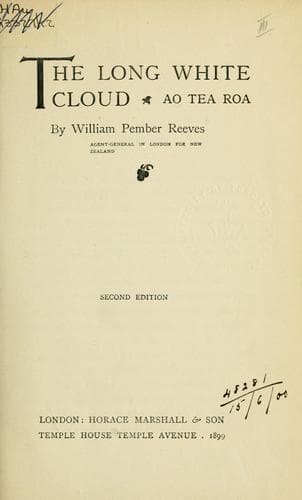
The Long White Cloud: "Ao Tea Roa"Reeves, William Pember
History
The Long White Cloud: "Ao Tea Roa"
Reeves, William Pember
Ethnology -- New Zealand; New Zealand
sent for aid to Australia, and drew thence all the Imperial soldiers
that could be spared. The Colony of Victoria, generous in the
emergency, lent New Zealand the colonial sloop-of-war _Victoria_, and
allowed the vessel not only to transport troops across the Tasman Sea,
but to serve for many months off the Taranaki coast, asking payment
for nothing except her steaming coal. By the end of the year there
were some 3,000 Europeans in arms at the scene of operations, and they
probably outnumbered several times over the fluctuating forces of the
natives. The fighting was limited to the strip of sea-coast bounded by
the Waitara on the north and the Tataramaika plain on the south, with
the town of New Plymouth lying about midway between. The coast was
open and surf-beaten, the land seamed by ravines or "gulleys," down
which the rainfall of Egmont streamed to the shore. Near the sea
the soil was--except in the settlers' clearings--covered with tough
bracken from two to six feet high, and with other troublesome growths.
Inland the great forest, mantling the volcano's flanks, and spreading
its harassing network like a far-stretching spider's web, checked
European movements. From the first the English officers in command
in this awkward country made up their minds that their men could do
nothing in the meshes of the bush, and they clung to the more open
strip with a caution and a profound respect for Native prowess which
epithets can hardly exaggerate, and which tended to intensify the
self-esteem of the Maori, never the least self-confident of warriors.
A war carried on in such a theatre and in such a temper was likely
to drag. There was plenty of fighting, mostly desultory. The Maoris
started out of the bush or the bracken to plunder, to cut off
stragglers, or to fight, and disappeared again when luck was against
them. Thirteen tiresome months saw much marching and counter-marching,
frequent displays of courage--more courage than co-operation
sometimes,--one or two defeats, and several rather barren successes.
For the first eight months the advantage inclined to the insurgents.
After that their overweening conceit of their Waikato contingent
enabled our superior strength to assert itself. The Maoris, for all
their courage and knowledge of the country, were neither clever
guerillas nor good marksmen. Their tribal wars had always been affairs
of sieges or hand-to-hand encounters. Half the skill displayed by them
in intrenching, half the pluck they showed behind stockades, had
they been devoted to harassing our soldiers on the march or to loose
skirmishing by means of jungle ambuscades, might, if backed
by reasonably straight shooting, have trebled our losses and
difficulties.
Public-domain text, read in full here on John Shaqi.
Reviews
Reviews
No reviews yet
Be the first to share your thoughts on this work.
Elsewhere in the archive
Join the Discussion
Join the discussion
Sign in to leave a comment or review.
Sign InorCreate an account