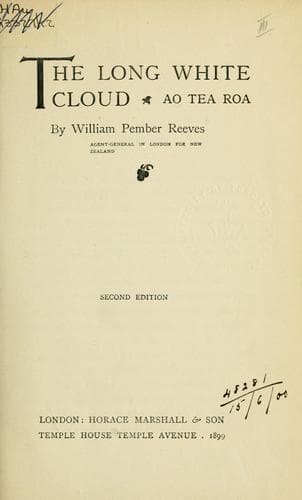
The Long White Cloud: "Ao Tea Roa"Reeves, William Pember
History
The Long White Cloud: "Ao Tea Roa"
Reeves, William Pember
Ethnology -- New Zealand; New Zealand
An angry collision followed between him and his ministers, and in
November, 1864, the Ministry, whose leaders were Sir William Fox and
Sir Frederick Whitaker, resigned. They were succeeded by Sir Frederick
Weld, upon whose advice Grey let the confiscation go on. Weld became
noted for his advocacy of what was known as the Self-reliance
Policy--in other words, that the Colony should dispense with the
costly and rather cumbrous Imperial forces, and trust in future to the
militia and Maori auxiliaries. And, certainly, when campaigning began
again in January, 1865, General Cameron seemed to do his best to
convert all Colonists to Weld's view. He did indeed appear with a
force upon the coast north of Wanganui. But his principal feat was
the extraordinary one of consuming fifty-seven days in a march of
fifty-four miles along the sea beach, to which he clung with a
tenacity which made the natives scornfully name him the Lame Seagull.
At the outset he pitched his camp so close to thick cover that the
Maoris twice dashed at him, and though of course beaten off, despite
astonishing daring, they killed or wounded forty-eight soldiers. After
that the General went to the cautious extreme. He declared it was
useless for regulars to follow the natives into the forest, and
committed himself to the statement that two hundred natives in a
stockade could stop Colonel Warre with five hundred men from joining
him. He declined to assault the strong Weraroa _pa_--the key to the
west coast. He hinted depressingly that 2,000 more troops might be
required from England. In vain Sir George Grey urged him to greater
activity. The only result was a long and acrid correspondence between
them. From this--to one who reads it now--the General seems to emerge
in a damaged condition. The best that can be said for him is that he
and many of his officers were sick of the war, which they regarded
as an iniquitous job, and inglorious to boot. They knew that a very
strong party in England, headed by the Aborigines Protection Society,
were urging this view, and that the Colonial Office, under Mr.
Cardwell, had veered round to the same standpoint. This is probably
the true explanation of General Cameron's singular slackness. The
impatience and indignation of the colonists waxed high. They had
borrowed three millions of money to pay for the war. They were paying
£40 a year per man for ten thousand Imperial soldiers. They naturally
thought this too much for troops which did not march a mile a day.
Public-domain text, read in full here on John Shaqi.
Reviews
Reviews
No reviews yet
Be the first to share your thoughts on this work.
Elsewhere in the archive
Join the Discussion
Join the discussion
Sign in to leave a comment or review.
Sign InorCreate an account