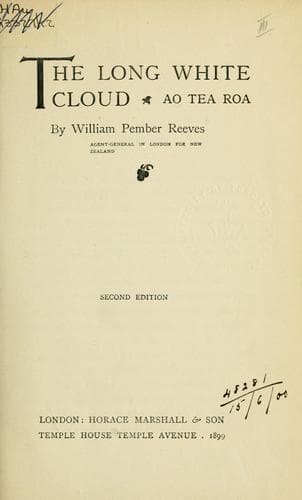
The Long White Cloud: "Ao Tea Roa"Reeves, William Pember
History
The Long White Cloud: "Ao Tea Roa"
Reeves, William Pember
Ethnology -- New Zealand; New Zealand
When the Waitara war broke out the white population did not number
more than seventy-five thousand. When Te Kooti was chased into the
King Country it had grown to nearly four times that sum, in the face
of debt, doubt, and the paralyzing effects of war. A great ally of
settlement had come upon the scene. In 1861 profitable goldfields were
discovered in Otago. The little Free Church colony, which in thirteen
years had scarcely increased to that number of thousands, was
thunderstruck at the news. For years there had been rumours of gold
in the river beds and amongst the mountains of the South Island. From
1857 to 1860 about £150,000 had been won in Nelson. In 1858, a certain
Asiatic, Edward Peters, known to his familiars as Black Pete, who had
somehow wandered from his native Bombay through Australia to Otago,
had struck gold there; and in March, 1861, there was a rush to a
short-lived goldfield at the Lindis, another spot in that province.
But it was not until the winter of that year that the prospector,
Gabriel Read, found in a gully at Tuapeka the indubitable signs of a
good alluvial field. Digging with a butcher's knife, he collected in
ten hours nearly five-and-twenty pounds' worth of the yellow metal.
Then he sunk hole after hole for some distance, finding gold in all.
Unlike most discoverers, Read made no attempt to keep his fortune
to himself, but wrote frankly of it to Sir John Richardson, the
superintendent of the province. For this he was ultimately paid the
not extravagant reward of £1,000. The good Presbyterians of Dunedin
hardly knew in what spirit to receive the tidings. But some of them
did not hesitate to test the field. Very soberly, almost in sad
solemnity, they set to work there, and the result solved all doubts.
Half Dunedin rushed to Tuapeka. At one of the country kirks the
congregation was reduced to the minister and precentor. The news went
across the seas. Diggers from Australia and elsewhere poured in by the
thousand. Before many months the province's population had doubled,
and the prayerful and painful era of caution, the day of small things,
was whisked away in a whirl of Victorian enterprise. For the next few
years the history of Otago became a series of rushes. Economically,
no doubt, "rush" is the proper word to apply to the old stampedes to
colonial goldfields. But in New Zealand, at any rate, the physical
methods of progression thither were laborious in the extreme. The
would-be miner tramped slowly and painfully along, carrying as much in
the way of provisions and tools as his back would bear. Lucky was the
man who had a horse to ride, or the rudest cart to drive in. When, as
time went on, gold was found high up the streams amongst the ice-cold
rivers and bleak tussock-covered mountains of the interior, the
hardships endured by the gold-seekers were often very great. The
country was treeless and wind-swept. Sheep roamed over the tussocks,
but of other provisions there were none. Hungry diggers were thankful
Public-domain text, read in full here on John Shaqi.
Reviews
Reviews
No reviews yet
Be the first to share your thoughts on this work.
Elsewhere in the archive
Join the Discussion
Join the discussion
Sign in to leave a comment or review.
Sign InorCreate an account