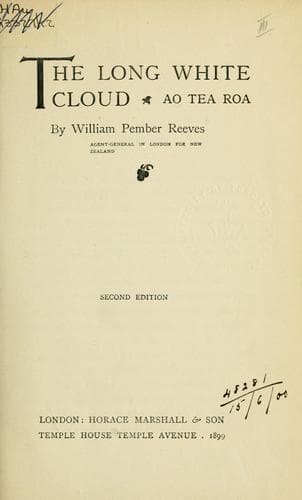
The Long White Cloud: "Ao Tea Roa"Reeves, William Pember
History
The Long White Cloud: "Ao Tea Roa"
Reeves, William Pember
Ethnology -- New Zealand; New Zealand
A few words will be in place here about the continuance and outcome of
the Public Works policy. Sir Julius Vogel quitted the Colony in 1876,
but borrowing for public works did not cease. It has not yet ceased,
though it has slackened at times. In 1879 a commercial depression
overtook the Colony. The good prices of wool and wheat sank lower and
lower; the output of gold, too, had greatly gone down. There had been
far too much private borrowing to buy land or to set up or extend
commercial enterprises. The rates of interest had often been
exorbitant. Then there happened on a small scale what happened in
Victoria on a larger scale twelve years later. The boom burst amid
much suffering and repentance. In some districts three-fourths of
the prominent colonists were ruined, for the price of rural produce
continued on the whole to fall relentlessly year after year until
1894. The men who had burdened themselves with land, bought wholly or
largely with borrowed money, nearly all went down. Some were ruined
quickly, others struggled on in financial agony for a decade or more.
Then when the individual debtors had been squeezed dry the turn
of their mortgagees came. Some of these were left with masses of
unsalable property on their hands. At last, in 1894, the directors of
the bank which was the greatest of the mortgagees--the Bank of New
Zealand--had to come to the Government of the day to be saved
from instant bankruptcy. In 1895 an Act was passed which, while
guaranteeing the bank, virtually placed it beneath State control,
under which it seems likely gradually to get clear of its
entanglements. This was the last episode in the long drama of
inflation and depression which was played out in New Zealand between
1870 and 1895. No story of the Colony, however brief, can pretend to
be complete which does not refer to this. The blame of it is usually
laid upon the public works policy. The money borrowed and spent by the
Treasury is often spoken of as having been wasted in political jobs,
and as having led to nothing except parliamentary corruption and an
eternal burden of indebtedness and taxation. This is but true to a
very limited extent. It was not the public borrowing of the Colony,
but the private debts of the colonists, which, following the
extraordinary fall in the prices of their raw products between 1873
and 1895, plunged so many thousands into disaster. Nine-tenths of the
money publicly borrowed by the Colony has been very well spent. No
doubt the annual distribution of large sums through the Lands and
Public Works departments year after year have had disagreeable effects
on public life. In every Parliament certain members are to be
pointed out--usually from half-settled districts--who hang on to the
Ministry's skirts for what they can get for their electorates. The
jesting lines at the head of this chapter advert to these. But they
must not be taken too seriously. It would be better if the purposes
Public-domain text, read in full here on John Shaqi.
Reviews
Reviews
No reviews yet
Be the first to share your thoughts on this work.
Elsewhere in the archive
Join the Discussion
Join the discussion
Sign in to leave a comment or review.
Sign InorCreate an account