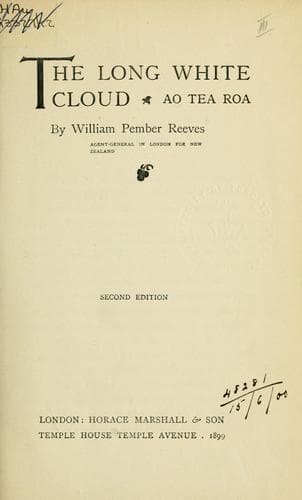
The Long White Cloud: "Ao Tea Roa"Reeves, William Pember
History
The Long White Cloud: "Ao Tea Roa"
Reeves, William Pember
Ethnology -- New Zealand; New Zealand
Slowly but surely the undying agrarian controversy passed with the
Colony's progress into new stages. In the early days we have seen the
battle between the "sufficient price" of Gibbon Wakefield and the
cheap land of Grey, the good and evil wrought by the former, the wide
and lasting mischief brought about by the latter. By 1876 price had
ceased to be the main point at issue. It was agreed on all hands that
town and suburban lands parted with by the Crown should be sold by
auction at fairly high upset prices; and that rural agricultural land
should be divided into classes--first, second, and third--and should
not be sold by auction, but applied for by would-be occupants prepared
to pay from £2 to 10s. an acre, according to quality. More and more
the land laws of the Colony were altered so as to favour occupation by
small farmers, who were not compelled to purchase their land for cash,
but permitted to remain State tenants at low rentals, or allowed to
buy the freehold by gradual instalments, termed deferred payments.
Even the great pastoral leaseholds were to some extent sub-divided as
the leases fell in. The efforts of the land reformers were for many
years devoted to limiting the acreage which any one person could
buy or lease, and to ensuring that any person acquiring land should
himself live thereon, and should use and improve it, and not leave it
lying idle until the spread of population enabled him to sell it at
a profit to some monopolist or, more often, some genuine farmer. As
early as 1856 Otago had set the example of insisting on an outlay
of 30s. an acre in improvement by each purchaser of public land.
Gradually the limiting laws were made more and more stringent, and
were partly applied even to pastoral leases. Now, in 1898, no person
can select more than 640 acres of first-class or 2,000 acres of
second-class land, including any land he is already holding. In other
words, no considerable landowner can legally acquire public land.
Pastoral "runs"--_i.e._, grazing leases--must not be larger than such
as will carry 20,000 sheep or 4,000 cattle, and no one can hold more
than one run. The attempts often ingeniously made to evade these
restrictions by getting land in the names of relatives, servants,
or agents are called "dummyism," and may be punished by
imprisonment--never inflicted--by fines, and by forfeiture of the land
"dummied."[1]
[Footnote 1: Many a good story is founded on the adventures of
land-buyers in their endeavours to evade the spirit and obey the
letter of land regulations. In 1891 a rhymester wrote in doggerel
somewhat as follows of the experiences of a selector who "took up" a
piece of Crown land--
"On a certain sort of tenure, which his fancy much preferred,
That convenient kind of payment which is known as the 'deferred.'
Public-domain text, read in full here on John Shaqi.
Reviews
Reviews
No reviews yet
Be the first to share your thoughts on this work.
Elsewhere in the archive
Join the Discussion
Join the discussion
Sign in to leave a comment or review.
Sign InorCreate an account